

Somewhere tonight a sixteen-year-old is holding his phone eight inches from his face in a bathroom, trying to hold his head perfectly level, because a stranger on a forum told him a photo taken from below adds a full point to his jaw. He will upload the picture. A few hours later he will be told, by other teenagers who have never met him, that he is a 4.25, that his midface is long, that his canthal tilt is negative, and that he should consider being grateful for his hair.
Measure yours · freeFace RatingA measured face score out of 10 from eight proportions, with the breakdown. About 30 seconds from one photo.Try it →He will not read this as cruelty. He will read it as data.
In February 2026 the American figure skater Alysa Liu, asked what her plan was for the Olympic free skate, told reporters it was "to mog." The clip travelled around the world with a small delay while newsrooms looked the word up. What they found was a vocabulary that had been developing for fifteen years in places most of them had never visited, built by young men who believed that a face could be measured, ranked and, with enough discipline, improved. Liu won gold. The word won too.
This is a field guide to that vocabulary: what PSL, looksmaxxing, ascending, mogging and Chad actually mean, where each one came from, and the difference between measuring a face and grading one. That last distinction is the whole story.
A scale with three initials and a body count
Ask anyone in the community what PSL stands for and they will tell you it is an acronym: PUAHate, SlutHate, Lookism. Three forums, in sequence, that between roughly 2009 and 2019 built the rating system everything else sits on.
PUAHate began in 2009 as a place for men who felt cheated by the pickup-artist industry. Its founding grievance was that "game," the scripted confidence the seduction coaches were selling, had not worked. Over a few years the forum arrived at a darker explanation: it had not worked because looks decide everything, and no amount of technique overcomes a weak face. Members began studying faces the way day traders study charts. Ideas that are now standard in the community, such as the importance of a short philtrum, a "compact midface" and a high facial width-to-height ratio, were argued into existence in those threads.
On May 23, 2014, a 22-year-old named Elliot Rodger killed six people in Isla Vista, California. He had been a PUAHate member, and had written of the forum that it was full of people "who take pleasure in putting down others." The site shut down the next day. SlutHate opened two days after that and absorbed the users, this time with a dedicated sub-forum for rating threads. When SlutHate's servers faltered, the crowd moved again, to Lookism.net, which had gone online in June 2015. Looksmax.org, the largest forum today, is not one of the three letters but is universally treated as their heir.
A widely circulated version of the scale uses an eight-point ceiling and places roughly 4 in the middle. Other guides and apps use different ranges, so a PSL number needs its scale attached. There is no established rule for converting it to a casual score out of ten. Our PSL rating guide explains the numbers, the features people discuss and the limits of those comparisons.
Community guides describe facial harmony, symmetry, proportions and other appearance characteristics. Some emphasize bone structure, but the judgments still come from photographs that include hair, skin, expression and lighting. The weighting depends on the guide or rater. Measuring a distance and assigning an attractiveness grade are separate steps; neither the forum origin nor the anatomical vocabulary makes the total score a validated instrument. See the community guide for the convention and its claims.
Ascending, and the rarer descending
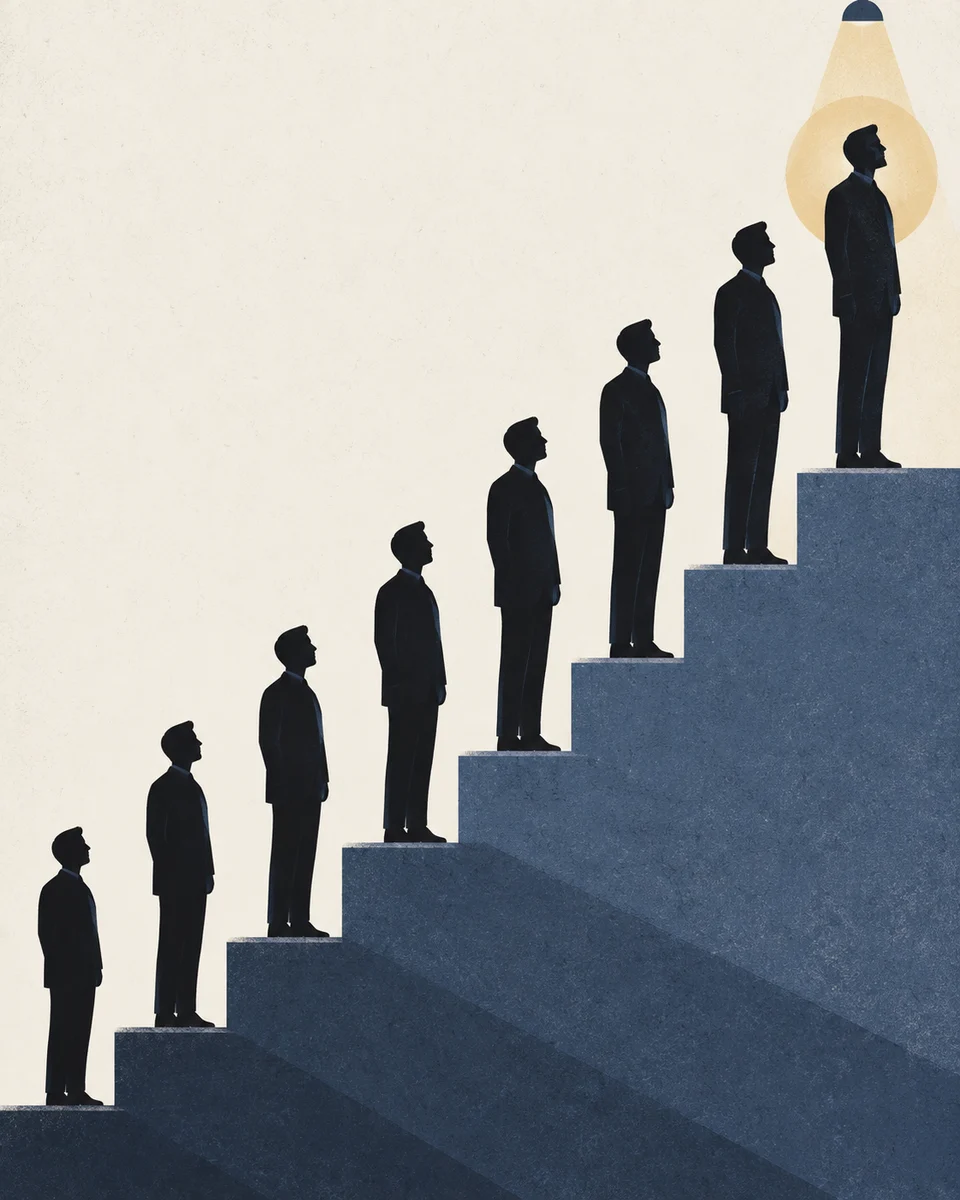
"Ascend" is the verb for moving up the scale. To ascend is to become visibly better looking, to jump from one tier to the next, and the word carries an almost religious weight in the forums: ascension is the thing that will finally end the loneliness. Its opposite, "descending," is used for ageing, weight gain and failed procedures.
The community's own threads are unsentimental about how often it happens. A long discussion on the largest forum in late 2024 asked, in effect, how many members ever actually ascend, and the honest answers were that most "ascensions" were teenagers finishing puberty. Another thread, titled "Ascending" shouldn't be your goal, argued that the promised transformation, respect, attention, being finally wanted, does not arrive with the new jawline, because the person inside the face is unchanged.
The word escaped its origins in April 2026, when Braden Peters, the 20-year-old streamer known as Clavicular and the most famous face of looksmaxxing, was hospitalised in Miami after an apparent overdose during a livestream. His first post from the hospital, in the community's own grammar, complained that the oxygen mask had made his face descend. The New York Times had profiled him two months earlier. He had been expelled from college for covert testosterone use, had filmed himself hitting his own face with a hammer, and had recommended small doses of methamphetamine to suppress appetite. Within the subculture he was, for a while, the proof that ascension was possible. Outside it he became the proof of what it costs.
Looksmaxxing: min-maxing, but for your face
The word is a compound of looks and maxxing, and the second half is borrowed from video games, where "min-maxing" means pouring every available point into the one stat that matters. The double x is a forum affectation, in the family of doxxing. The earliest documented uses are on Lookism.net and a sister site, Looksmaxxer.com, in the second half of 2015, and it reached 4chan's /r9k/ board that November.
For seven years it stayed underground. Then, in 2022 and 2023, it arrived on TikTok, where it looked almost wholesome. The forum version was "hardmaxxing": jaw surgery, hormones, limb-lengthening, and the ironic-but-not-entirely joke of "bonesmashing," striking the face with a hard object in the belief that the bone heals thicker. The TikTok version was "softmaxxing": skincare, haircuts, posture, and above all mewing, the practice of pressing the tongue to the roof of the mouth in the hope of reshaping the jaw. Mewing has billions of views and, as we wrote in a separate piece, zero clinical trials.
By 2026 Merriam-Webster had added a slang entry for the word, and the suffix had escaped entirely. People now "gymmaxx," "sleepmaxx" and, jokingly, "LinkedInmaxx." A linguist who has traced the vocabulary, Adam Aleksic, argues that terms like maxxing and mogging began on anonymous boards as proof of membership: with no usernames, fluency in the slang was the only way to show you belonged. The words were the uniform. Most of the teenagers wearing them now have no idea.
Mogging: the verb for being out-faced
To mog someone is to outshine them so completely, by height, jaw, build or general presence, that they look worse simply for standing next to you. The person doing it is the mogger, the person it happens to is the moggee, and the word takes modifiers: you can be height-mogged, frame-mogged, jaw-mogged.
The etymology is pickup-artist jargon. AMOG, "alpha male of the group," was the man in a bar whom the seduction coaches taught their students to neutralise. Bodybuilding forums shortened it to a verb; the earliest documented uses on 4chan's /fit/ board date to 2016, including a British poster complaining in December of that year about being "height-mogged." From there it lived in fitness circles for nearly a decade.
Its 2026 explosion was driven by Clavicular's followers, who declared him "brutally frame-mogged" after a gym photo beside a much larger fraternity president, and by TikTok "mog wars," head-to-head looks contests between male creators. Then came the figure skater, and the word crossed into family newspapers. The Guardian ran a piece in June asking whether it was a problem that a term from misogynist forums was now used by everyone's younger siblings; NPR devoted a Word of the Week to it. Most current usage is ironic. But the joke still runs on a physical comparison, and it still has a winner and a loser.

Chad: from Chicago slang to a marble ideal
"Chad" is older than all of it. In 1990s and 2000s Chicago it was mildly mocking slang for a certain kind of affluent young man, the male counterpart to "Trixie," and a satirical website called the Lincoln Park Chad Society was chronicling his exploits by 2006. On August 9, 2013, an Urban Dictionary user defined "Chad Thundercock" as the stereotypical alpha who succeeds with women without trying, and 4chan adopted him as a character.
The incel boards gave him a job. In their cosmology Chad was the genetically gifted man who took all the women, and the source of everyone else's misery; the 2018 Toronto van attacker's last public post promised to "overthrow all the Chads and Stacys." The same year, a small MS Paint drawing changed the word's temperature. A thread on 4chan's /r9k/ in April 2016 had catalogued the "virgin walk," hands in pockets, eyes down; in March 2017 someone drew it, and by June the "Virgin vs. Chad" comparison was one of the most remixed templates on the internet. The format made Chad funny, and funny things stop being frightening. On Tumblr, users decided Chad was simply a well-adjusted guy and started shipping him with the Virgin.
Then came the photographs. In October 2017 a Reddit user linked to an Instagram account belonging to Sleek'N'Tears, an art project by the Russian photographer Krista Sudmalis, whose heavily edited black-and-white images of a model named Ernest Khalimov looked like statues that had learned to smirk. A 4chan poster the next day called him "Gigachad," and the name stuck. That the images were manipulated, and that people still argue over whether the man in them exists as pictured, is almost the point: the ideal was always a composite.
In looksmaxxing today, Chad is not an insult and not a person. He is the top of the scale, a description of bone: forward-grown maxilla, sharp gonial angle, positive canthal tilt, hooded "hunter" eyes. On the forums people speak of him the way architects speak of a golden section. He is the thing the calipers are pointed at.

FaceIQ, Umax and the business of the number
For most of the scale's history, getting your number meant posting a photo and waiting to be insulted. The apps changed that. Umax, launched in December 2023 and the most downloaded of them, asks for a selfie and returns scores for jawline, cheekbones, masculinity and "potential," then charges $3.99 a week for the plan to raise them. Fortune reported that year that it outranked Zillow's rental app in the App Store and that around nine in ten of its users were men between 16 and 45. Its scoring is partly powered by a general-purpose language model, which is to say the number is an opinion with a decimal point.
FaceIQ began as a YouTube rater who scored faces with a published formula, harmony, angularity, dimorphism, miscellaneous, and sold private ratings for a few hundred dollars. His FaceIQ Labs app now measures "harmony" from photos, and the forums that once paid him have turned on him: the recurring complaint is that the app overrates, flags flaws that are not there and disagrees with his own earlier verdicts. A separate app using the FaceIQ name on Google Play, from an unrelated developer, has a one-star review from a user who says he photographed a potato with eyes and got the same score as his own face.
The reviews of the whole category read the same way. On the most popular "LooksMax AI" app, a user reports the same pose scoring anywhere from 6.7 to 8.4 depending on the day. That is not a defect in one product. It is what happens when a social verdict is dressed as a measurement. The number feels precise because it has a decimal, and it moves because nothing underneath it is fixed.
What the numbers cost
The clinicians have been unusually direct. A 2025 study in Sociology of Health & Illness analysed more than 8,000 comments from a major looksmaxxing forum and found that in every rating thread in its sample, the person asking to be rated was insulted, unfavourably compared to other men, or encouraged to harm himself by at least one participant. A 2025 commentary in Facial Plastic Surgery & Aesthetic Medicine described looksmaxxing as straddling the line between self-enhancement and self-harm. The Lancet Child & Adolescent Health published a narrative review that December describing adolescents and young adults as developmentally vulnerable to body-image disorders of this kind, including muscle dysmorphia. A mental-health researcher writing for PBS in 2026 made the plainest point: seen clinically, the behaviours look like symptoms of an eating disorder in male form, fixated on leanness rather than thinness, and the media's habit of profiling the practitioners as eccentric celebrities is how those symptoms go untreated.
None of that means the measurements are fake. Canthal tilt is a real angle. The gonial angle is a real angle. Facial thirds, width-to-height ratio and midface length are things a ruler can find, and two people with a ruler will find roughly the same thing. What is not real is the step where those numbers are averaged into a single score and the score is treated as a verdict on the person. That step was invented by a vote on a forum that no longer exists, calibrated against the faces its members happened to admire, and it has never been validated against anything.
Measure the face. Skip the grade.
There is a version of all this that is simply useful. A lot of what the forums obsess over is soft tissue: puffiness that flattens a jawline, a brow held low from screen posture, a mouth corner that sits lower on one side because that is the side you chew on. Those things move. The bone underneath does not, and the honest thing a tool can do is tell you which is which.
That is the line Symmi draws. It measures the same things the forums argue about, canthal tilt, jaw angle and width, facial thirds, width-to-height ratio, symmetry, from 478 landmarks on a controlled capture, and it reports each one as a number with a typical band. It does not add them up into a grade, and it never will. Partly that is because the grade is not science. Mostly it is because the boy in the bathroom does not need another stranger to tell him what he is worth. He needs to know that his jaw reads soft because of fluid, not bone, that it will look different after the photo is taken from further away, and that the four things on his list that can actually change are the only four worth a minute of his time.
The words will keep spreading. Mog is in the Olympics now; maxxing is on LinkedIn. That is fine. Words are cheap. The scale underneath them is the thing to leave behind.
Sources
- Halpin M, Gosse M, Yeo K, et al. When help is harm: health, lookism and self-improvement in the manosphere. Sociology of Health & Illness, 2025. PubMed 40069550 — qualitative analysis of 8,072 comments on a looksmaxxing forum; in every rating thread analysed, users were insulted, unfavourably compared or encouraged to self-harm.
- Konig DJ, Sidhu AS, Corpuz GS. Looksmaxxing: straddling the inflection between self-enhancement and self-harm. Facial Plastic Surgery & Aesthetic Medicine, 2026 (online December 2025). PubMed 41460661 — a short commentary for facial plastic surgeons on looksmaxxing practices and their risks.
- Nagata JM, Hur JO, Murakami K, et al. Muscle dysmorphia in adolescents and young adults. The Lancet Child & Adolescent Health, 2026 (online December 2025). PubMed 41349557 — narrative review describing adolescents and young adults as developmentally vulnerable to body-image disorders such as muscle dysmorphia.
- Pelzer B, Kaati L, Cohen K, Fernquist J. Toxic language in online incel communities. SN Social Sciences, 2021. doi:10.1007/s43545-021-00220-8 — measures toxic language on three incel forums and outlines PUAHate's 2009 origin as an anti-pickup-artist forum.
- News reporting, cited for events and usage: The Guardian, "'Mogging' is suddenly everywhere. Is that a problem?", June 2026; NPR, Word of the Week on "mogging", April 2026; Today.com on Alysa Liu and "mog", February 2026.
- News reporting on Braden Peters: The New York Times profile, February 2026; The New York Times, "What We Know About Clavicular's Apparent Overdose", April 2026; NBC News on the April 2026 hospitalisation.
- Fortune, looksmaxxing apps that rate teen boys' faces, July 2024 — Umax's launch, chart position and user base.
- Slate on PUAHate and the Isla Vista attack, May 2014 — the forum's shutdown after the attack.
- PBS NewsHour / The Conversation, May 2026 — a mental-health researcher on looksmaxxing behaviours as possible symptoms of eating disorders and body dysmorphia.
- Reference and community sources, cited for word history and community usage rather than as evidence: Merriam-Webster, "looksmaxxing" slang entry; Know Your Meme entries for Looksmaxxing, Virgin vs. Chad and GigaChad; looksmax.org, "The history of PSL"; looksmax.org PSL rating guide.
- App Store and Google Play user reviews for Umax, LooksMax AI and FaceIQ, cited as user reports only.