
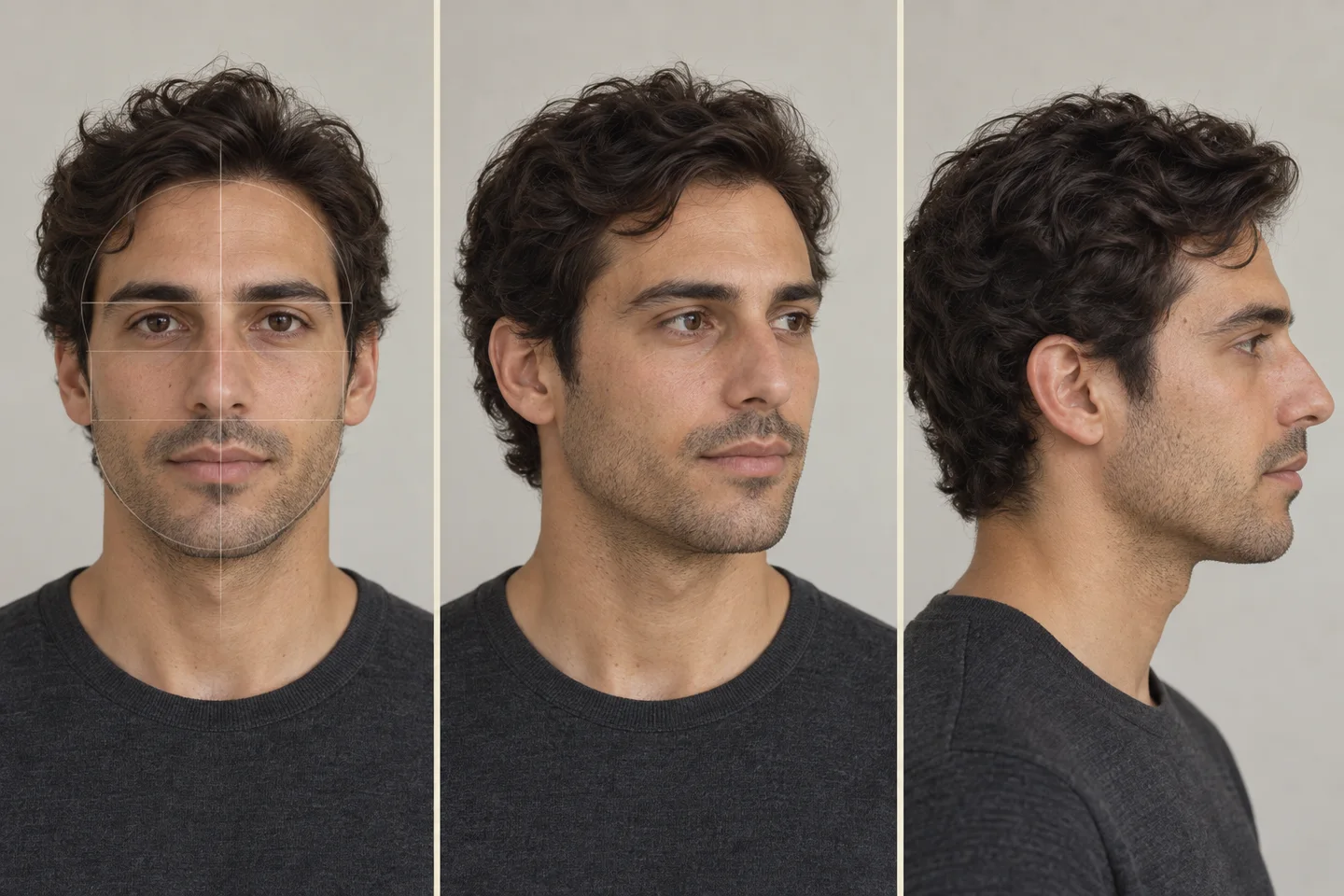
A PSL rating is a community score for facial appearance, associated with looksmaxxing forums. A widely circulated version uses an eight-point ceiling, with roughly 4 described as average. That makes a comment like “5 PSL” different from a casual “five out of ten.” It also makes the scoring system worth checking before you interpret the number. Community scale guide, 2021.
The useful questions are what the rater considered, which photograph they used, and how they reached their judgment. A decimal score by itself answers none of those questions.
This guide explains the terminology, the features people discuss, how facial harmony fits in, and what a measurement tool can actually tell you.
What does PSL stand for?
PSL refers to PUAHate, SlutHate and Lookism, the online communities associated with the rating culture. The initials describe its forum history, rather than a scientific test. A 2025 study of looksmaxxing content traces the scale within the wider circulation of incel and manosphere ideas. That context helps explain the rigid hierarchy and sometimes demeaning language attached to the scores. Solea and Sugiura, 2025.
You do not need to adopt that worldview to understand the vocabulary. This article uses plain descriptions for the scores and focuses on what can be checked.
For the wider history of terms such as mogging, ascending and Chad, see our looksmaxxing dictionary.
How does the PSL scale work?
The chart below summarizes the language of one influential eight-point guide. It describes a forum convention, not a measured distribution of people.
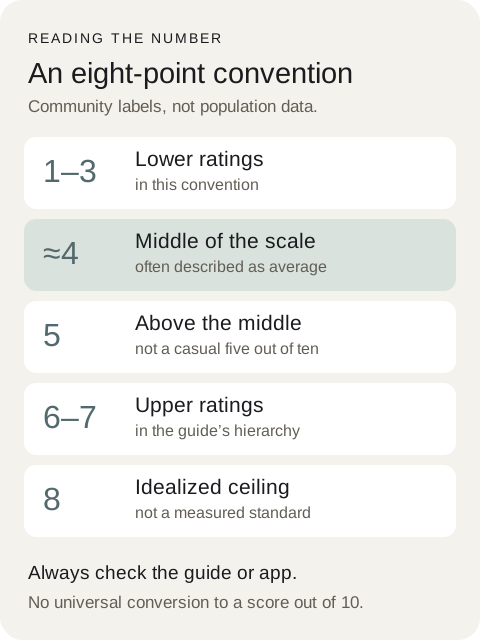
In that guide, roughly 3.5–4.5 occupies the middle, 5 is above average, 6 and 7 describe progressively higher judgments, and 8 is treated as an almost unattainable ideal. The author also disputes the percentile interpretation offered within the same post. Those percentiles should not be repeated as population facts. Original guide.
If another site uses a ten-point scale, check its own definitions. Neither adding two points nor multiplying by 10/8 establishes an equivalent attractiveness judgment: the categories and assumptions may differ. Always keep the scale attached to the number.
Labels such as LTN, MTN and HTN expand to low-, mid- and high-tier “normie.” Other discussions use Chadlite and Chad for upper categories. Treat these as community slang; their boundaries can vary by guide. They do not identify biological types.
What features do PSL raters look at?
Community guides commonly discuss harmony, balance, symmetry, facial shape, sex-typical appearance, distinctive features and averageness. Some writers emphasize bone structure, but even their judgments are made from an image containing skin, hair, soft tissue, expression and lighting. A community explanation of the rating criteria.
Here are useful translations of the vocabulary you may encounter:
- Harmony: how features appear together, including their relative size and spacing.
- Symmetry: correspondence between the left and right sides. This is one aspect of a face, not a complete description of its appearance.
- Proportions: comparisons between distances, such as eye spacing relative to eye width or lower-face height relative to total face height.
- Contour and projection: the visible outline of the jaw and cheek region, and the relationships between forehead, nose, lips and chin in profile.
- Sexual dimorphism: features a rater interprets as more masculine or feminine. Such an interpretation does not measure someone's hormone levels or determine which look they should want.
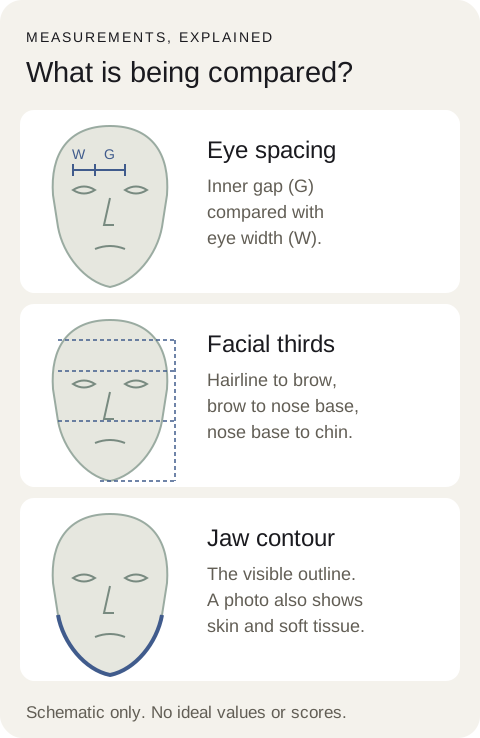
The jump from a distance to a rating is where interpretation enters. Measuring an eye-corner angle gives an angle. Deciding how many points that angle should add to a face requires a preference model and a weighting rule. A list of anatomical terms does not supply those rules.
There is also a visibility limit: a surface photograph cannot isolate the underlying bone from everything covering it. A sharp-looking jaw in directional light is an observation about that picture; it is not a direct measurement of the mandible.
Is facial harmony part of PSL?
Yes. It is explicitly included in community descriptions of the score. It refers to how the parts relate to one another, rather than whether each feature would receive a high rating in isolation. The exact weight given to harmony is not established by a shared formula.
For example, a discussion of eye spacing should specify what is being compared: the inner-corner gap, pupil distance, eye width or face width. Those are different measurements. A claim that someone has “good harmony” can otherwise conceal several different judgments behind one phrase.
Our guide to the harmony of your face explains those relationships without converting them into a rank. For individual ratios and their evidence, see the facial ratios guide.
PSL versus appeal
When someone contrasts PSL with “appeal,” they are usually separating a structural rating from the overall impression a person creates. The community distinction is informal, and different raters may draw the boundary differently.
An everyday impression also includes expression, hairstyle, grooming and the setting in which someone is seen. A photograph captures only some of that information. It cannot represent your voice, manner or how an interaction feels.

Research provides a useful reason to be careful about a single photograph. Todorov and Porter found that different images of the same person could produce substantially different social impressions; which image people preferred also depended on the intended context. That supports checking image selection. It does not validate a PSL-to-appeal conversion. Todorov and Porter, 2014.
Preferences also differ between viewers. A twin study by Germine and colleagues found that individual differences in facial preferences were explained largely by experiences unique to the individual. Shared preferences and personal taste can both exist. Germine and colleagues, 2015.
Why can the same face receive different scores?
There are at least three separate sources of variation to consider.
The photograph changed
Camera distance changes perspective; head rotation changes the apparent relationship between the sides; expression changes the outlines around the eyes and mouth. Lighting can make a contour easier or harder to see.
Ward and colleagues modeled how short camera distances increase apparent nose breadth relative to cheekbone width. Their findings concern photographic geometry, not a change in the person's nose. This is one reason a close selfie and a portrait taken farther away should not be treated as interchangeable measurement inputs. Ward and colleagues, 2018.
The rubric or rater changed
Before comparing two ratings, check whether they use the same scale, criteria and weighting. If those are not stated, you cannot tell whether a difference reflects the picture, the preferences or the scoring rules.
The software changed the interpretation
An automated result may combine landmark measurements with learned judgments or a language model's interpretation. To assess a particular product, you need its actual method. The letters “AI” do not tell you whether it was tested on repeated photos, compared with independent raters or evaluated across different groups.
A score displayed as 5.37 has two decimal places. That display alone does not establish accuracy to one hundredth of a point.
Is PSL scientifically validated?
The sources reviewed for this article did not establish a validated, shared PSL scoring instrument. They included community rating guides, research about the culture, and studies of facial perception. These are different kinds of evidence.
Research can examine whether particular features influence average ratings under specified conditions. Validating an entire scoring system would additionally require a defined rubric, reproducible inputs, agreement testing, and a clear account of what the output predicts. A paper about symmetry does not automatically validate an app's total score.
Nor should the absence of a universal formula be read as “appearance never matters.” It means the precision and scope of a claim need to match its evidence.
A more useful way to analyze your face
Start with a question you can describe: whether a photograph is tilted, how your facial thirds compare, or which frame shape you prefer. Then choose the appropriate view and measurement.
- Make the photograph consistent. Use even light, a level camera, a relaxed expression and a frontal view for frontal measurements. Step back rather than holding the camera very close; crop afterward if needed.
- Inspect the landmarks. Hair, glasses, shadows and head rotation can make a detected point less reliable. Retake the photo if the marked points do not match the feature.
- Read the definition. Use eye spacing, facial thirds, face symmetry or jawline for specific questions, and check the methodology.
- Separate measurements from preferences. For a haircut, beard or glasses choice, compare the full look under similar conditions. A style you enjoy does not need to raise a forum score.
Symmi's browser tools estimate image landmarks and report specific measurements. They do not provide a validated PSL rating or convert facial geometry into a prediction of dating success. Their useful output is a more precise description of the photograph you supplied.
Common questions
Is 5 PSL the same as 5/10?
Not necessarily. Read the scale definition first. A number from an eight-point convention cannot be compared directly with an undefined ten-point opinion.
Does better symmetry guarantee a higher PSL score?
No. A rater may consider other features, their relationships and the photograph itself. Symmetry describes only part of what they are judging.
Can a haircut change my PSL rating?
A haircut can change the image someone is judging. Whether a particular rater counts that change depends on their rubric. It is more useful to compare the style you prefer than to promise a numerical increase.
Should I compare my score with a celebrity chart?
Celebrity charts mix selected photographs, styling, retouching and different capture conditions. They can illustrate a community's preferences, but they do not provide a controlled benchmark for your face.
Does Symmi give me a PSL score?
The free website tools give you measurements for defined features, not a PSL rank. Choose a free tool based on the feature you want to understand.
The cover and presentation comparison are AI-generated editorial illustrations of fictional adults. The diagrams explain concepts; they are not beauty targets or customer measurements.