
Eyes · guide + free test
Hunter eyes vs prey eyes
The difference is three measurements, not a vibe: how the outer corner sits, how open the eye is, and how close the brow rides. Here are both, side by side, with the numbers that separate them and a test for your own.
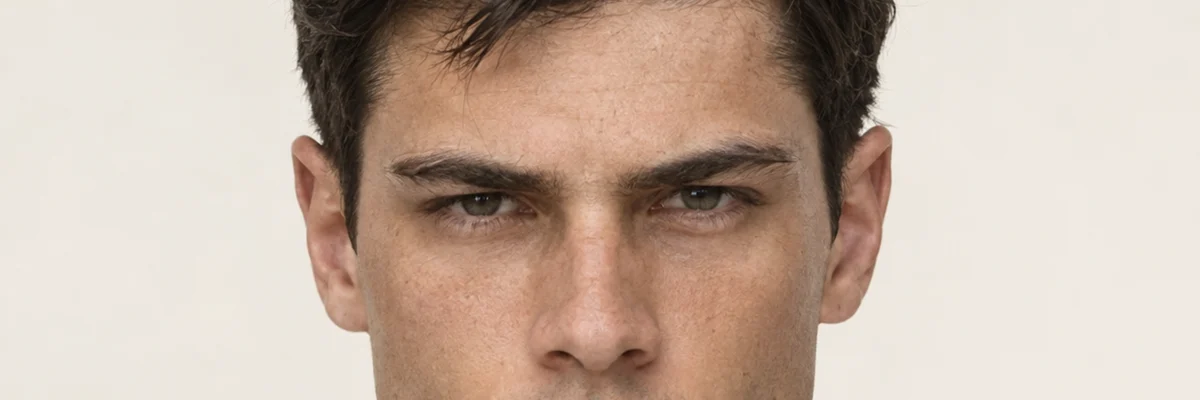
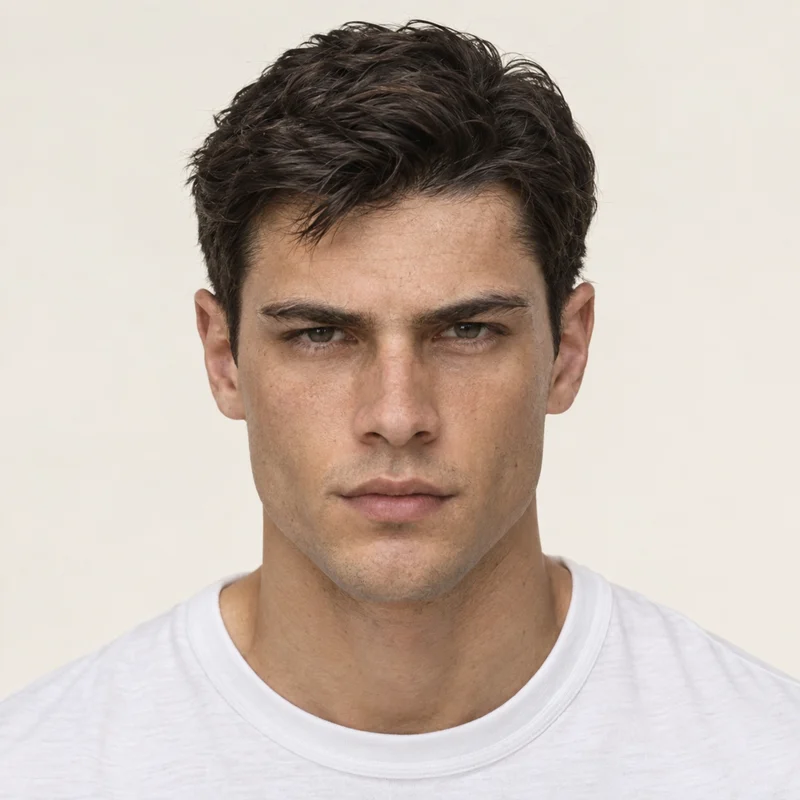
Hunter eyes
Positive tilt · narrow opening · low brow · hooded lid
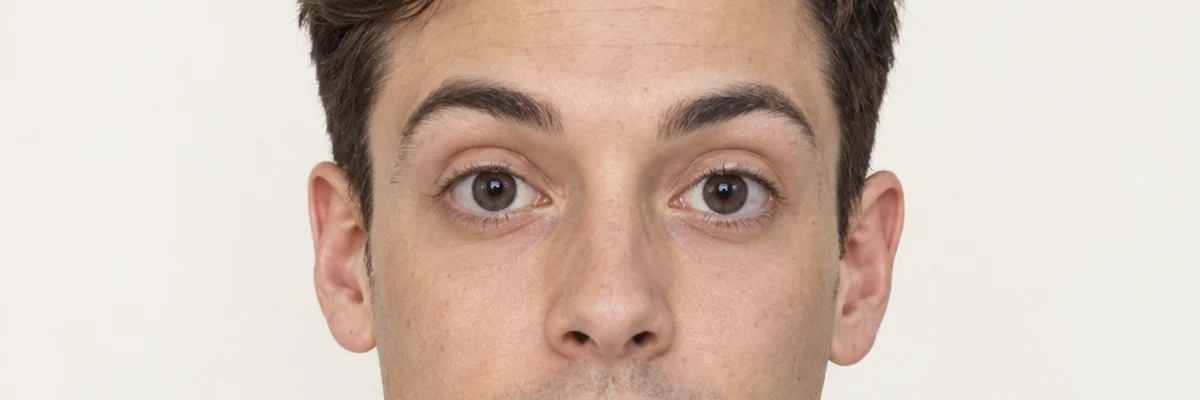

Prey eyes
Round opening · high brow · exposed lid · softer tilt
Both faces are AI-generated to show the two eye areas on otherwise similar faces. Nobody real is being rated.
What actually differs
Six traits, three of them measurable from a photo.
| Trait | Hunter | Prey |
|---|---|---|
| Canthal tilt | Positive: outer corner higher than the inner, roughly +2° to +8° | Neutral or negative: outer corner level with or below the inner, about −4° to +2° |
| Eye opening (height ÷ width) | Narrow, almond: 0.32 or less | Round, open: 0.38 or more |
| Brow position | Low and straight, close to the eye | High and arched, well above the eye |
| Upper eyelid | Hooded, little or no lid skin showing | Exposed, a clear band of lid skin |
| Eye socket | Deep-set under a strong brow ridge | Shallow, the eye sits forward |
| Reads as | Focused, intense, older | Open, approachable, younger |
The first three rows are what the test below measures. Socket depth needs a 3D scan, and the last two rows are how people read the first four. Thresholds are Symmi's landmark scale, which reads canthal tilt a few degrees lower than calliper measurements quoted on forums.
Free test · runs in your browser
Which do you have?
Upload a straight-on photo. 478 landmarks, head tilt removed, three readings, no upload to any server.
Drop a photo, paste one, or choose a file
Straight-on, whole face visible, even light. JPG, PNG or WebP.
Runs in your browser. Your photo never leaves your device.
Bone vs trainable
Can prey eyes become hunter eyes?
Two of the three readings are anchored in bone. The canthal tilt is set by where the orbit puts the corners of the eye, and socket depth is the orbit itself; neither moves without surgery. The brow and the lid are different. The brow sits where the frontalis and the brow depressors hold it, and a brow held high from habit can settle lower with training. Puffiness above the lid, from fluid, sleep or salt, hides the hooded look and clears with the morning routine. So the honest answer is: the tilt is yours for life, the brow gap and the apparent opening can move a little, and the app tells you which of your three readings is which before you spend time on any of them.
Sources
What this is based on.
The measurement and its reference ranges come from published research. Studies use different methods and populations, so compare your number with the range shown on this page rather than with other tools.
- 1.
Rhee SC, Woo KS, Kwon B (2012). Biometric study of eyelid shape and dimensions of different races with references to beauty. Aesthetic Plastic Surgery. PubMed 22810555
Eyelid shape, exposure and canthal measurements compared across ethnic groups.
- 2.
Lee JY, Choung HW, Choung PH (2020). Diagnostic analysis of vertical orbital dystopia and canthal tilt for surgical correction. Journal of the Korean Association of Oral and Maxillofacial Surgeons. PubMed 33377462
Defines the canthal tilt angle used in the eye-corner reading.
- 3.
Kartynnik Y, Ablavatski A, Grishchenko I, Grundmann M (2019). Real-time facial surface geometry from monocular video on mobile GPUs. arXiv. arXiv:1907.06724
The face-mesh model that places the 468 surface landmarks this tool measures from.
- 4.
Ablavatski A, Vakunov A, Grishchenko I, et al. (2020). Real-time pupil tracking from monocular video for digital puppetry. arXiv. arXiv:2006.11341
The iris model that adds 10 eye landmarks (478 in total), used for pupil-based reference lines.
Our own data: how much each reading moves when the same face is photographed again is published on the methodology page. How we choose sources.
FAQ
What are prey eyes?+
Prey eyes is the looksmaxxing term for round, open eyes with a neutral or slightly negative canthal tilt, a high brow and visible upper eyelid. The name comes from the idea that prey animals have wide, forward-open eyes for spotting danger, while predators have narrow, hooded ones. It is slang, not anatomy, but the three features it points at are real and measurable.
Is one better than the other?+
No. Hunter eyes read as intense and are the current looksmaxxing ideal; prey eyes read as friendly and are the older beauty ideal, especially for women. A large share of famous faces sit on the prey side. What matters for how a face reads is the whole set, not one feature.
Do I have hunter eyes or prey eyes?+
Most people are a mix: a positive tilt with a round opening, or a hooded lid with a high brow. The tool above measures the three readings on your photo and tells you which of them fall on the hunter side. Two or three out of three is a hunter-leaning eye area; zero or one is prey-leaning.
Can prey eyes become hunter eyes?+
The bone cannot change: canthal tilt and socket depth are set by the orbit. The brow and the lid have a soft-tissue component. A brow that sits high partly from habit can settle lower with training, and puffiness above the lid can hide the hooded look. Those two readings can move a little; the tilt will not.
Why does my result differ from what a forum rated me?+
Forum ratings are done by eye, from photos taken at different distances and angles. This page measures landmark to landmark after removing head tilt. The measured tilt also reads a few degrees lower than the numbers people quote, because it uses the true corner points rather than the eyelid margin.
Three readings here.
Nineteen in the app.
Eye area, structure, harmony and skin, each against its ideal band, bone vs trainable, and a plan. 3D on Face ID iPhones.