
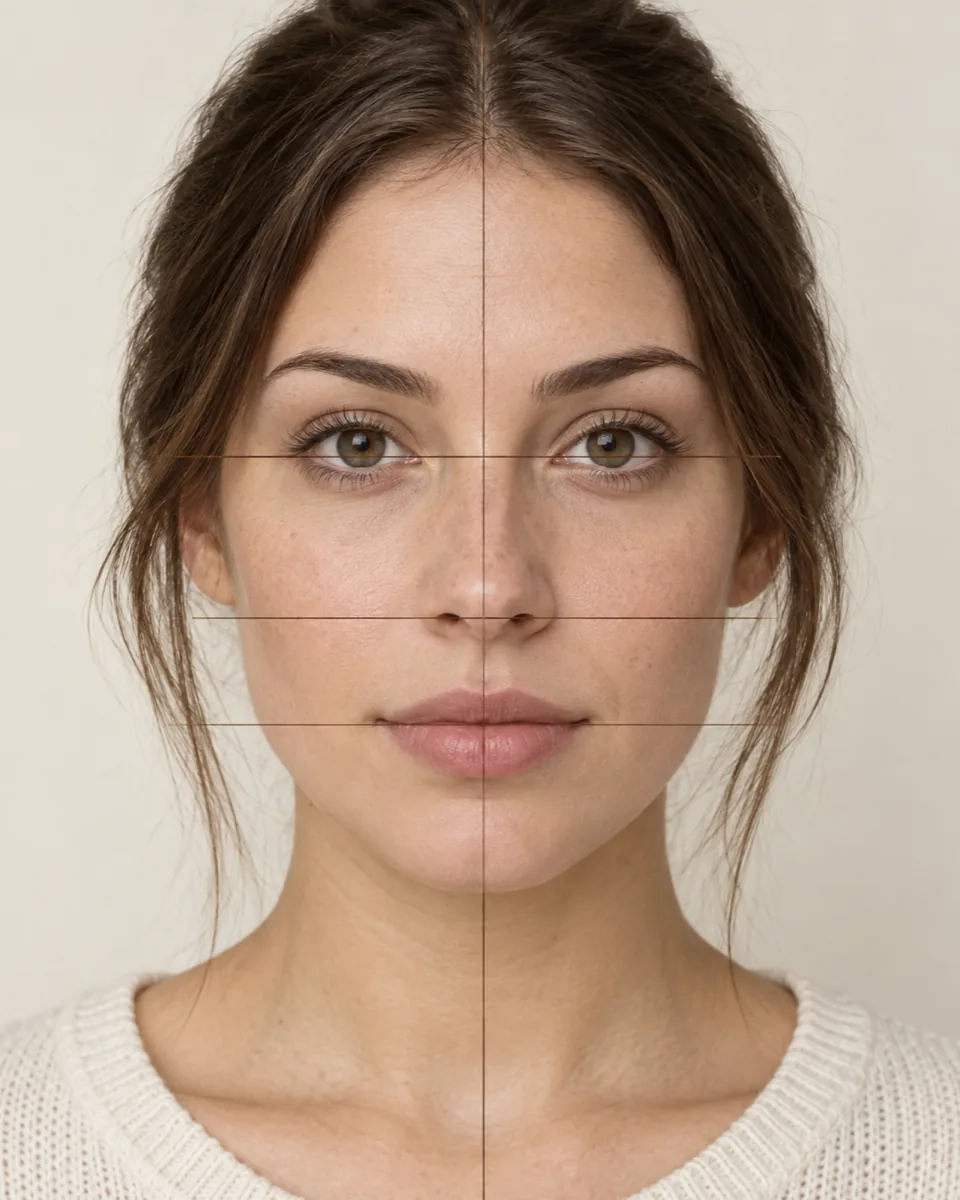
Short answer: most of the list is convention: numbers voted into place on forums, not measured against anyone's ratings. Three items have real studies behind them, and even those give bands, not targets. Every one of them is photo-dependent.
A single thread, copied for a decade, is the source of nearly all of it: about fifteen ratios, each with an "ideal" precise to two decimals, which makes them look measured. Below, each ratio gets four things: what it measures, the forum's ideal, what the literature supports, and whether it can move.
Width ratios
fWHR (facial width-to-height ratio)
Definition. Bizygomatic width, the distance between the widest points of the cheekbones, divided by the height from the upper lip to the brow midpoint. The research papers measure that height to the upper eyelid instead, and the two versions do not return the same number. Forum ideal: 1.8 or higher. Research: this is the one ratio with a genuine literature. Carré and McCormick found it predicted reactive aggression in men, explaining 15% of the variance in the lab and 29% and 9% in two samples of hockey players. That is a dominance finding, not an attractiveness finding, and the effects are small and disputed. Population mean sits near 1.9; faces outside roughly 1.7 to 2.1 read as noticeably long or wide. No study shows 1.8 is a threshold for anything. Can it change? The width is bone. The height moves with brow position and lip posture, the visual width with cheek fullness. The biggest lever is the lens: the same faces shot at different focal lengths changed width-to-height with effect sizes of 3.45 to 4.41. Measure your fWHR at arm's length and again from across the room and you will see it.
Bizygomatic to bigonial (cheekbone to jaw width)
Definition. Cheekbone width divided by the width between the two jaw angles (gonions). Forum ideal: 1.35 in the original thread, but most replies reject that and say the jaw should be 85 to 95% of cheekbone width. The community never agreed. Research: no controlled study links this ratio to ratings; forum convention. What the literature does say is that bigonial width is the worst thing you can measure from a flat photo: in 96 people, photographic jaw width agreed with direct measurement at an ICC of 0.16, off by 9.3 mm on average, against a clinical threshold of 2 mm. The jaw angle is also the most asymmetric point on a normal face, 4.6 mm left to right in a 3D study of 48 adults. Can it change? The bone cannot. The masseter over it moves by about a millimetre with chewing habit; the fat and fluid in front of the angle move with weight and time of day. Head yaw of 5 degrees is enough to distort the width. The jawline tool measures it with head roll removed.
Mouth to nose width
Definition. Distance between the mouth corners divided by the width of the nose at the alar base. Forum ideal: 1.5 to 1.62. Research: this is one of the nine neoclassical canons that Farkas tested on 153 young adults in 1985. The abstract reports that the best-fitting canons matched only 40% and 37% of faces, and that the canons "do not represent the average facial proportions". The 1.62 version is the golden ratio applied by hand and has no study of its own. Can it change? Neither width is trainable. Nose width in a photo is mostly distance: a 12-inch selfie makes the nose base read about 30% wider than a portrait taken further back. Smiling widens the mouth, which is why the golden ratio tool measures at rest.
Nose width to cheekbone width
Definition. Alar width as a fraction of bizygomatic width. Forum ideal: under one part in 3.5. Research: the closest canon, nose width equals one quarter of face width, was one of Farkas's two best performers, and still fit only 37% of normal faces. That is a description of typical variation, not an ideal. Can it change? Bone and cartilage. The photo distance effect above applies fully.
Vertical ratios
Facial thirds
Definition. Hairline to brow, brow to nose base, nose base to chin, each as a share of face height. Forum ideal: equal. Research: Farkas tested the equal-thirds canon and found the vertical profile proportions had the poorest fit of all nine canons. Equal thirds are a drawing convention; a normal face is usually a few points off, with a slightly longer lower third in men. The often-quoted percentages for which third is "most often" wrong come from a jaw-deformity clinic of 1,460 patients, not the general population. Can it change? The upper third depends on where you put the hairline, the least certain landmark on any face. The middle and lower thirds are bone. Chin-down posture shortens the lower third in a photo. Read yours on the facial thirds tool.
Lower to full face ratio
Definition. Nasion (the bridge point between the eyes) to chin, divided by hairline to chin. Forum ideal: 0.62 or higher, the golden ratio again. Research: no controlled study; forum convention. It shares the hairline problem above, so the denominator is an estimate on most photos.
Midface ratio
Definition. Interpupillary distance divided by the height from nasion to upper lip. Forum ideal: 1.0 to 1.1. Research: no attractiveness study defines this ratio; forum convention. It is a real, repeatable measurement, and a compact midface is what the forums mean by "short midface", but the band is a preference, not a finding. Can it change? Bone. Lip posture moves the lower landmark by a millimetre or two; nothing else does. The fWHR tool returns it alongside width-to-height.
Forehead height
Definition. Hairline to brow. Forum ideal: "three fingers". Research: none; it is a rule of thumb, literally. It also depends on whose fingers.
Head height to cheekbone width
Definition. Full head height divided by bizygomatic width. Forum ideal: 1.35. Research: no controlled study; forum convention. Hair makes the top of the skull unmeasurable in almost every photo.
Eye ratios
Canthal tilt
Definition. The angle of the line from the inner eye corner (medial canthus) to the outer corner (lateral canthus), relative to horizontal; outer corner higher is positive. Forum ideal: 4 to 6 degrees. Research: the study usually cited is Bashour and Geist, 2007. It is real, but not what the forum thinks: raters preferred female faces whose medial canthal tilt had been accentuated in Photoshop 93% of the time. No degree threshold, no male faces, a manipulation rather than a natural range. A real cue, and a made-up number. Landmark-based tools also read about 3 degrees lower than calliper measurement because they use the corner point rather than the lid margin, so a forum "6" and a landmark "3" can be the same eye. Can it change? The angle is set by the orbit. What changes is how it reads: a raised brow or puffiness at the outer corner flattens it, and head roll in the photo adds or subtracts directly. The canthal tilt tool levels the pupils before measuring.
Palpebral fissure length to height
Definition. Eye opening, corner to corner, divided by its height at the widest point. Forum ideal: 3.0 to 3.5. Research: no controlled study of this ratio against ratings; forum convention. Can it change? Height moves with fatigue, brow position and expression all day. Length does not.
Eye separation ratio (ESR)
Definition. Interpupillary distance divided by bizygomatic width. Forum ideal: 0.45 to 0.47. Research: the neoclassical version, eyes one eye-width apart, is one of the horizontal canons Farkas tested; the ratio as the forum writes it has no study. Can it change? No. It is the most fixed number on the list.
Eye-mouth-eye angle (EME)
Definition. The angle at the mouth centre between lines drawn to each pupil. Forum ideal: 47 to 50 degrees. Research: no controlled study; forum convention. Its inputs are the two most fixed distances on the face, so it changes only with camera distance and with how much the mouth is open.
Eyebrow tilt
Definition. Angle of the line from brow head to brow tail. Forum ideal: 5 to 6 degrees. Research: none; and 93% of people have at least a millimetre of brow-height asymmetry, so the two brows usually give two answers. Can it change? Muscle. Brows lift and drop with expression and are the easiest landmark to move.
Lip and chin
Lower to upper lip height
Definition. Vermilion height of the lower lip divided by the upper. Forum ideal: 1.62. Research: a real study exists. Popenko and colleagues had 428 raters rank morphed images of 20 white women and found an upper-to-lower ratio of 1:2 most attractive and 2:1 least. That is a lower lip twice the upper, not 1.62 times, in one population and one sex. It is the second of the three items with evidence, and it argues with the forum number. Can it change? Lip fullness is soft tissue and moves with hydration, temperature and expression by the hour. Anything more is a clinic decision.
Chin to philtrum
Definition. Height from lower lip to chin point divided by the philtrum, nose base to upper lip. Forum ideal: 2.0 to 2.25, with arguments pushing it to 3. Research: no controlled study; forum convention. The chin height itself is a useful number: 60 to 72% of the lower third is typical, and a short chin is what reads as recessed on a front view. Can it change? Bone. Posture moves the chin point in a photo; nothing you do moves it in the mirror.
Profile only
Gonial angle
Definition. The angle at the jaw corner between the ramus (the vertical part of the mandible) and the mandibular body, seen from the side. Forum ideal: 115 to 130 degrees. Research: no controlled attractiveness study of the angle itself; forum convention. It is also a bone angle read through soft tissue, and 2D shape measurements like it are distorted by head roll and yaw. Can it change? No. Fat over the angle changes how sharp it looks, not what it is.
Cervicomental (submental-cervical) angle
Definition. The angle under the chin between the underside of the jaw and the front of the neck. Forum ideal: 105 to 120 degrees. Research: this is the third item with a real study, and it is the best of the three. Naini and colleagues changed the angle on a profile silhouette in steps from 90 to 130 degrees and had 75 laypeople, 75 orthognathic patients and 35 clinicians rate each. 90 to 105 degrees was rated acceptable. Angles up to 120 were slightly unattractive to laypeople and clinicians and very unattractive to patients; by 125 to 130 every group rated them very unattractive. The forum's band sits mostly in the zone the study rated slightly unattractive. Can it change? The most changeable item on the list: the angle is drawn by fat and fluid under the chin and by head position. Chin forward and level opens it; head-forward posture and submental fat close it. It is also the reading most sensitive to a photo taken from below.
Measure yours
Every number above is photo-dependent before it is face-dependent: focal length changes width ratios, distance changes the nose, roll changes the tilt, yaw changes the jaw. A reading only means something on a level, straight-on capture at portrait distance, and it means most against your own earlier reading rather than a forum's decimal.
The facial ratios tool returns the whole list from one photo, in the browser, with the typical band beside each. For single readings with more detail there are fWHR, canthal tilt, facial thirds, golden ratio and jawline.
Sources
Carré JM, McCormick CM. Proceedings of the Royal Society B 2008;275(1651):2651-2656, PubMed 18713717. Farkas LG et al. Plastic and Reconstructive Surgery 1985;75(3):328-338, PubMed 3883374. Bashour M, Geist C. Ophthalmic Plastic and Reconstructive Surgery 2007;23(1):52-56, PubMed 17237692. Popenko NA et al. JAMA Facial Plastic Surgery 2017;19(4):261-267, PubMed 28208179. Naini FB et al. Journal of Maxillofacial and Oral Surgery 2016;15(4):469-477, PubMed 27833339. Focal length and width-to-height: Třebický V et al., PLoS ONE 2016;11(2):e0149313. Selfie distance and nose width: Ward B et al., JAMA Facial Plastic Surgery 2018;20(4):333-335. Photographic versus direct measurement in 96 people: Lim YC et al., Frontiers in Public Health 2022;9:813058; head rotation and 2D measurement: Gateño J et al., Journal of Oral and Maxillofacial Surgery 2011;69(3):655-662. 3D asymmetry in 48 adults: PMC3481973. Brow asymmetry prevalence: Macdonald KI et al., Journal of Otolaryngology-Head and Neck Surgery 2014;43:36. Clinic-sample thirds figures: Severt TR, Proffit WR, 1,460 dentofacial-deformity patients.