
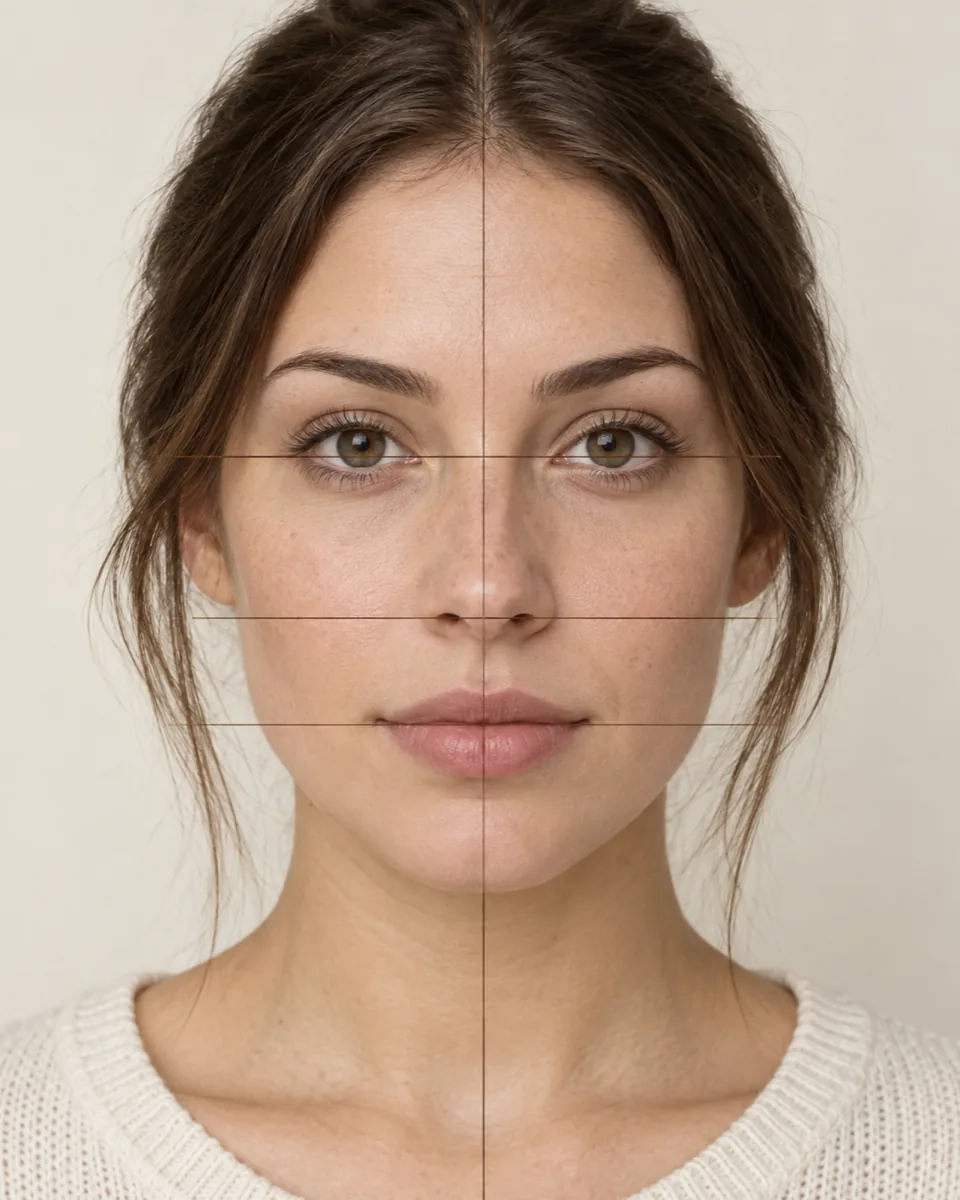
You take a selfie, look at it, and something is off. The nose is wider than you remember. The jaw looks softer. Then someone photographs you from across the room and you look like yourself again. Most people file this under "I'm not photogenic." It isn't that. It's optics, and it has been measured.
Measure yours · freeMirror Face TestYour left half doubled, your right half doubled. About 30 seconds from one photo.Try it →The experiment
Researchers photographed 45 people in the same session, same lighting, same expression, changing only the lens: 50 mm, 85 mm and 105 mm equivalents. Then 369 raters judged the photos. The share of women judged attractive went from 19.2% at 50 mm to 41.0% at 85 mm. For men it went from 13.5% at 50 mm to 51.1% at 105 mm. The effect sizes were enormous, between 1.7 and 2.9 standard deviations, and the measured face width-to-height ratio shifted even more.
Nothing about the faces changed. The distance between the camera and the face changed, and with it the perspective.
Why a short lens widens your face
A wide lens close to the face exaggerates whatever is nearest to it. The nose is nearest. A separate clinical paper estimated that a selfie taken at about 12 inches makes the base of the nose look roughly 30% wider than a photo taken from five feet away. That is why clinical facial photography generally favours longer, portrait-length lenses, often quoted as 90 to 105 mm equivalents: at that range proportions distort far less.
Your phone's front camera is a wide lens, and your arm is short. You are looking at the unflattering end of the experiment every single day.
A quick test
Take a selfie at arm's length. Then hand the phone to someone and have them photograph you from the other side of the room, cropped to the same framing. Same nose. The first one is visibly wider.
What this means for measuring a face
If ratings can swing by 38 points from focal length alone, a number that comes from "upload a selfie and let a model react to it" is mostly measuring the lens. This is why Symmi controls the capture instead of accepting whatever you have: straight-on, even light, neutral face, and on Face ID iPhones a TrueDepth 3D scan that records the geometry at true scale rather than through a wide lens. The readings are geometry, angles and ratios between landmarks, and a rescan uses the same method, so the comparison is between your face and your face, not between two lenses. The lens is not the only reason a selfie looks wrong, either: the mirror has been showing you a flipped face your whole life, and the unflipped one takes some getting used to.
Sources
- Třebický V, Fialová J, Kleisner K, et al. Focal length affects depicted shape and perception of facial images. PLoS ONE, 2016. PubMed 26894832 — 45 people photographed at 50, 85 and 105 mm and judged by 369 raters; the 50 mm photos were rated less attractive and gave smaller fWHR.
- Ward B, Ward M, Fried O, et al. Nasal distortion in short-distance photographs: the selfie effect. JAMA Facial Plastic Surgery, 2018. PubMed 29494735 — models how much a short camera distance enlarges the apparent nose.