
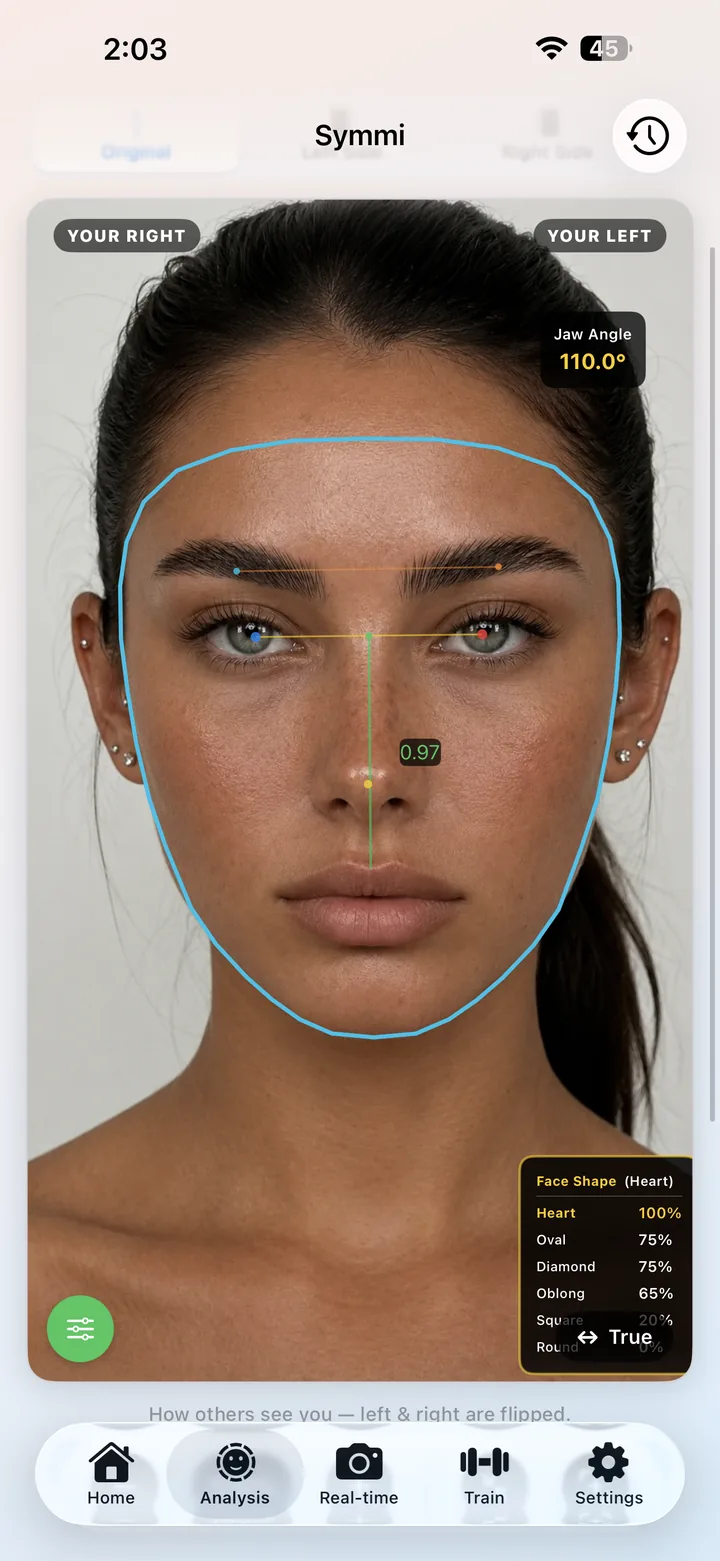
Here is the uncomfortable fact behind "why do I look so bad in photos": the face you know is a reflection. Every mirror you have ever looked in flipped you left to right. Every photo, and every other person, sees the unflipped version. You have spent your life memorising a face that nobody else has seen.
Measure yours · freeMirror Face TestYour left half doubled, your right half doubled. About 30 seconds from one photo.Try it →The experiment
In 1977, psychologists photographed 37 women face-on and printed each photo twice, once as taken and once mirrored. Each woman reliably preferred her mirrored version, the one she sees in the mirror every morning. Then the researchers showed the same pair to her friends and partner. They reliably preferred the true, unflipped version. The result replicated in a second experiment within the same paper.
There was nothing wrong with anyone's face. There were simply two versions of it, and each group preferred the one it knew.
Why it matters
Faces are not symmetric. Everyone's chin sits a little to one side, one brow sits a little higher, one eye is a little more open. When a face is flipped, all of those small offsets swap sides. Your visual system has learned one arrangement, and the swapped arrangement reads as a subtly different person. That is the entire "inverted filter" effect that sends people spiralling. The filter did not show you your real face. It showed you an unfamiliar one. Those are not the same thing.
A quick test
Take any photo of yourself and flip it horizontally. It will suddenly look right. Now show a friend both versions and ask which is you. They will pick the original.
Two views, one set of numbers
Symmi shows every scan in both orientations. True is how others see you. Mirror is how you see yourself. The measurements underneath do not change when you flip the picture: a 2.3 degree canthal tilt is 2.3 degrees in both views, and a chin that sits 1.6 mm left of centre sits 1.6 mm left in the true view whichever way you look at it. That is the point of measuring. The feeling that something is off is real. The numbers tell you how much, and whether anyone else could see it.
Sources
- Mita TH, Dermer M, Knight J. Reversed facial images and the mere-exposure hypothesis. Journal of Personality and Social Psychology, 1977. doi:10.1037/0022-3514.35.8.597 — women preferred mirror-image prints of their own faces, while their friends and partners preferred the true image.