
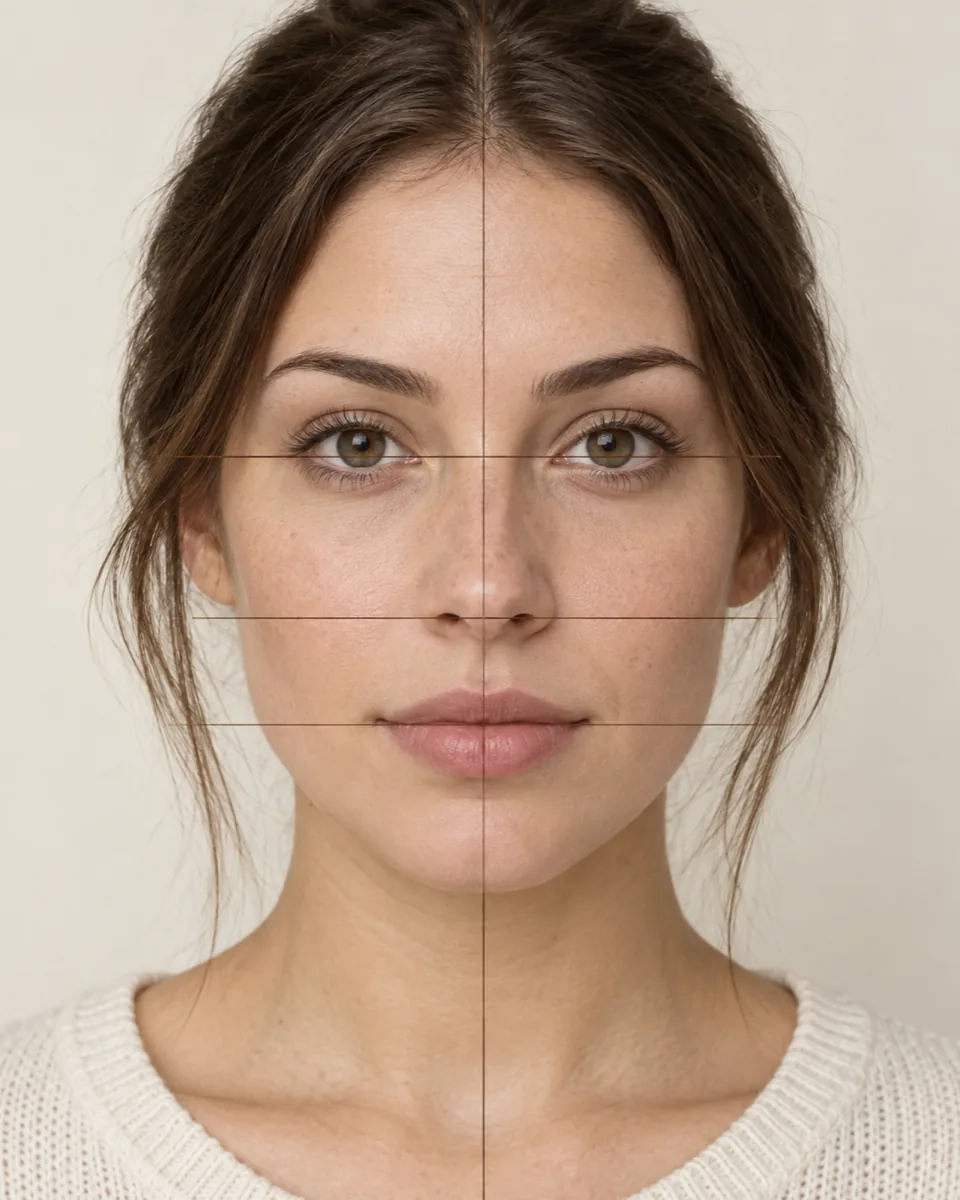
The question under every face-symmetry search is not really "am I asymmetric". Everyone is (the exception that matters, sudden or progressive asymmetry, is a medical question, not a cosmetic one). The real question is "can anyone see it". That has been measured, and the numbers are kinder than the internet.
Measure yours · freeFace Symmetry TestSymmetry index plus eight left-right readings. About 30 seconds from one photo.Try it →The detection thresholds
A systematic review of perception studies asked untrained observers to spot asymmetry in faces that had been altered by known amounts. The thresholds at which people started to notice were: eyelids about 2 mm, mouth corners about 3 mm, brows about 3.5 mm, nose tip about 4 mm, and the chin about 6 mm. Some of the studies in the review suggest that people who look at faces for a living, such as orthodontists, pick up smaller differences than lay observers do.
How sensitive people are to asymmetry in their own face has been studied less.
How asymmetric is normal
Very. In 100 consecutive patients measured before eyelid surgery, 93% had at least one eyelid or brow measurement that differed left to right by 1 mm or more. 75% differed by 2 mm or more. 37% by 3 mm or more. The average mid-brow height difference was 1.77 mm. Brow position is set by a tug of war between the muscle that lifts the forehead and the muscles that pull the brow down, and the lifting muscle is often recruited unevenly.
Put the two studies together: most people carry 1 to 2 mm of brow or lid asymmetry, which sits at or below even the most sensitive threshold in the review (2 mm, for the eyelids). The stranger across the table sees nothing, and even when they do see it, symmetry barely predicts attractiveness.
Why measure at all, then
Because the feeling of "something is off" does not come with a ruler. Someone with a 1.2 mm brow difference and someone with a 4 mm chin shift feel the same worry and search the same phrase. Only one of them has something a camera can see, and only the second one has anything to work on.
Symmi gives you the reading: brow height left and right, chin offset from the midline, eye openness, jaw angle on each side, 13 symmetry markers in total. You see the number next to the ideal band, and you see whether it is above or below the line where people notice. For most readings on most faces, the honest answer is "in range, and invisible to anyone but you". For the ones that are not, the app tells you which are structural and which respond to muscle, posture and fluid.
Sources
- Wang TT, Wessels L, Hussain G, et al. Discriminative Thresholds in Facial Asymmetry: A Review of the Literature. Aesthetic Surgery Journal, 2017. PubMed 28200081 — systematic review of perception studies; asymmetry starts to be noticed at about 2 mm for the eyelids, 3 mm for the mouth corners, 3.5 mm for the brows, 4 mm for the nose tip and 6 mm for the chin.
- Macdonald KI, Mendez AI, Hart RD, et al. Eyelid and brow asymmetry in patients evaluated for upper lid blepharoplasty. Journal of Otolaryngology - Head & Neck Surgery, 2014. PubMed 25294556 — in 100 consecutive patients, 93% had at least one brow or lid measurement differing left to right by more than 1 mm; the mean mid-brow difference was 1.77 mm.