
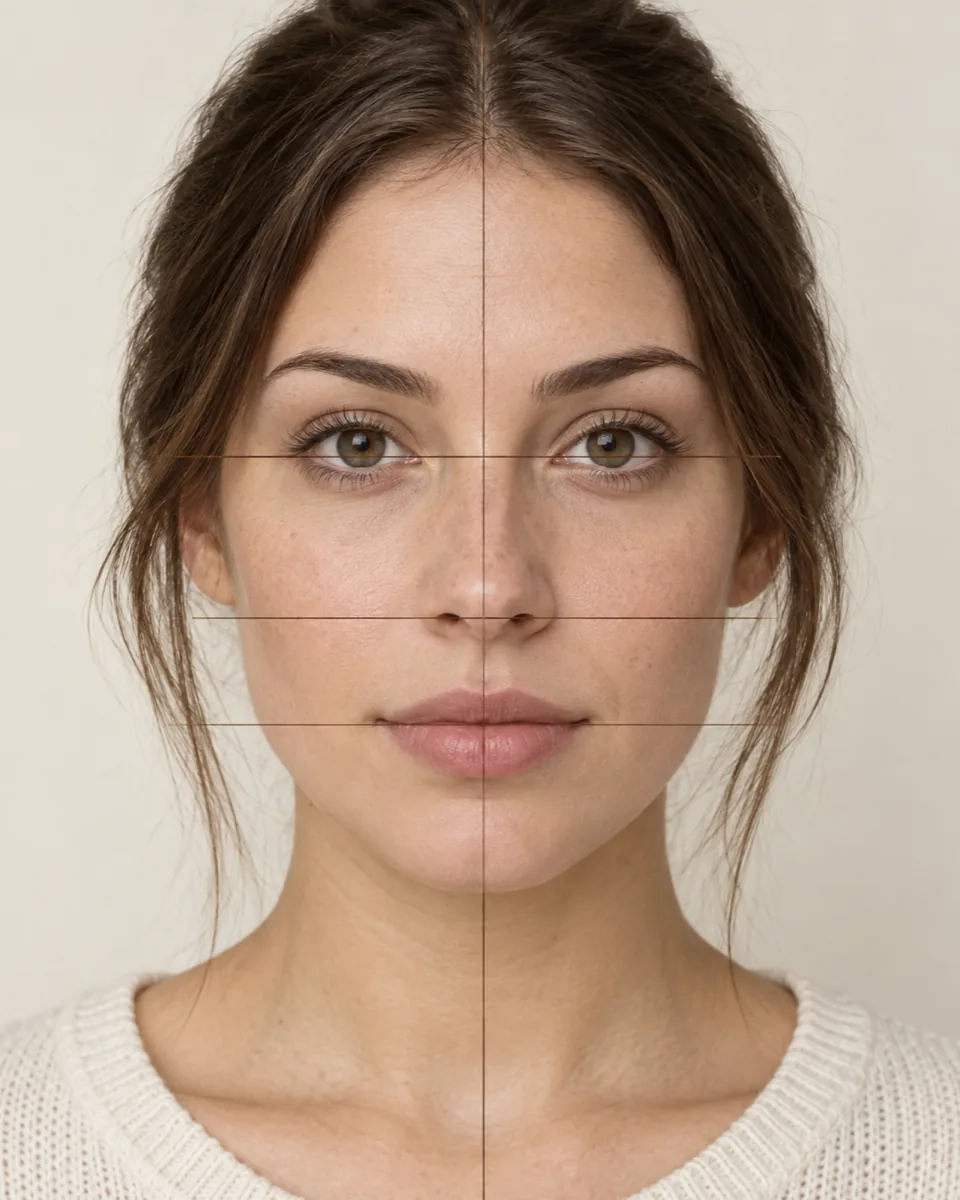
Verdict: works a little, for cheek fullness. For symmetry, nobody has measured it. Face yoga has one peer-reviewed study behind it, and that study is smaller, shorter and narrower than the people quoting it on TikTok remember.
The study everyone cites from memory
In every face yoga argument online, someone brings up "the Northwestern study". Almost nobody links it, so here it is. In 2018, dermatologists at Northwestern University published a pilot in JAMA Dermatology. Twenty-seven women aged 40 to 65 were enrolled in a 20-week program of 30-minute facial exercise sessions, daily at first and then on alternate days. Sixteen finished. Two blinded dermatologists rated standardised photographs at the start, at 8 weeks and at 20 weeks.
Two things moved. Upper cheek fullness and lower cheek fullness both improved, and the raters' estimate of the women's age dropped from 50.8 years at baseline to 48.1 years at week 20. Everything else the raters scored, including forehead lines, glabellar lines, crow's feet, nasolabial folds and marionette lines, showed no meaningful change.
Now the part that matters for this question. Symmetry was not an outcome. Nobody measured whether the left and right sides got closer to each other. The authors themselves listed the limits: a small sample, only middle-aged women, eleven dropouts and no control group. It is a pilot, and it says so.
What "works a little" means here
Take the finding at face value and it is modest and specific. Twenty weeks of thirty-minute sessions produced fuller-looking cheeks and a rated age about two and a half years younger, in the women who stuck with it. That is a real, measured result, and it is more than most face trends have. It is also a result about volume, not balance.
Fuller cheeks can make a face read as more even, because a sunken side reads as the weaker side and any fullness softens that contrast. But the exercises were done on both sides equally, so there is no reason to expect them to close a left-right gap, and no data that they did.
Why symmetry is a harder target than fullness
The jaw angle is the most asymmetric point on a normal face: in a 3D scan of 48 adults with normal bites, the chin and jaw angle differed left to right by 4.6 mm on average, the cheekbones by 3.3 mm, the mouth corners by 2.2 mm. Those are bone and deep soft-tissue differences. A muscle exercise reaches the layer over them.
The one muscle where a training effect on asymmetry has actually been measured is the masseter, and the whole lifetime effect of chewing on one side is about 1 mm of thickness. A muscle that barely responds to decades of daily loading is not going to respond dramatically to a five-minute routine. The mewing literature tells the same story from the other direction: the bone does not move.
The honest case for doing it anyway
None of this is a reason to stop. The 2018 study is small, but it is positive, and the mechanism is plausible: expressive muscles held in slow contractions can hypertrophy a little, and a little volume in the cheek shows. There is a second benefit the study did not measure but most people notice, which is that a routine makes you look at your face with a purpose instead of with dread. That changes what you see.
What it will not do is fix a chin that sits off centre or a brow that sits higher on one side. If that is the goal, the useful thing is to know your numbers first. A symmetry index drawn on your own photo tells you where the difference actually is, and how big. Anything under about 3 mm is below the threshold most people can see, which for many faces ends the argument before the routine starts.
What to do with this
- If your goal is fuller-looking cheeks, the evidence is thin but positive. Expect a small change over months, not weeks.
- If your goal is symmetry, measure first. Most differences are smaller than they feel.
- Treat any before-and-after that changes the lighting, the lens or the expression as unmeasured. The 2018 study used standardised photographs for a reason.
- Rescan under the same light and framing after a few months. A change shows up as a number or it did not happen.
Sources
Alam M, Walter AJ, Geisler A, et al. Association of Facial Exercise With the Appearance of Aging. JAMA Dermatology 2018;154(3):365-367, doi:10.1001/jamadermatol.2017.5142, PubMed 29299598. 3D soft-tissue asymmetry in 48 adults: PMC3481973. Wang TT et al., Aesthetic Surgery Journal 2017;37(4):375-385 (perception thresholds).