
Verdict: only a clinic can, and only partly. Orthodontics moves teeth and, in a child, can influence how the jaw grows. In an adult it can fix a crooked dental midline and a crossbite, which changes the smile and sometimes where the lower jaw rests. It does not move the chin on the bone, and there is no trial showing it corrects facial asymmetry.
The question every orthodontist gets weekly
"My teeth are straight now, why is my face still crooked?" One commenter on an aligner forum put it plainly: this question comes up every week. The answer is that there are three different things that can be off centre, and braces reach only one of them cleanly.
- The dental midline: the line between your two front teeth. Braces move this.
- The functional shift: where the lower jaw slides when the teeth meet. Fixing a crossbite can remove this.
- The skeletal midline: where the chin sits on the mandible. Braces do not move this in an adult.
If your chin sits 4 mm to the left, straightening the teeth will make the smile symmetrical inside a face that is still 4 mm to the left. That is a real improvement. It is not the one most people were hoping for.
Where orthodontics genuinely helps: the growing face
A unilateral posterior crossbite makes the lower jaw slide sideways on closing to find tooth contact. It is common: 8.4% of children in primary dentition, 7.2% in mixed. In children around age 8 with this shift, the condyle (the jaw joint head) was already asymmetric, index 10.7% versus 4.2% in controls, and 3D scans of 78 crossbite children against 156 controls put the resulting asymmetry in the lower third of the face.
Correct the crossbite early and the sideways slide stops, and the jaw is free to grow without that daily push. This is the strongest case for orthodontics as an asymmetry treatment, and it is a case about children. There is still no randomised trial showing that correcting it prevents adult facial asymmetry; the mechanism is solid, the long-term proof is missing.
Even in children, the power of appliances over bone is smaller than people assume. A Cochrane review of 27 trials in 1,251 children found that functional appliances worn daily changed the final jaw relationship by 0.02 degrees on average. Teeth move readily. Bone, even growing bone, moves a little.
The adult case
In an adult, the skeleton is set. Braces or aligners can align the dental midline, level a tilted bite plane and correct a crossbite. If a functional shift was pulling the jaw to one side on closing, removing it can let the jaw rest a few millimetres more centred, and the chin comes with it. That is the most an adult can expect from orthodontics alone, and it is worth having.
A quick self-check: open slightly, then close very slowly onto your back teeth while watching your chin in the mirror. If it slides sideways in the last millimetre, you have a functional shift, and that part is treatable. If it closes straight down and the chin is still off centre, the offset is skeletal.
For skeletal asymmetry, the clinic route is orthognathic surgery: repositioning the jaw itself, usually with orthodontics before and after. That is a surgical decision with its own assessment, and this article is not the place to make it. Talk to an orthodontist or a maxillofacial surgeon, and ask them to show you which of the three midlines is off on your own records.
The part nobody mentions at the consultation
Straightened teeth do not stay straight on their own. The University of Washington post-retention series, following patients for decades, found that with a success threshold of 3.5 mm of crowding, about 30% of four-premolar-extraction cases were still successful at 10 years and about 10% at 20 years. No pre-treatment variable predicted who would hold. A 37-year follow-up of 41 patients with mild crowding went from 3.31 mm before treatment to 0.58 mm after to 3.67 mm at the end, worse than before they started.
About 40% of patients stop wearing their retainer as instructed, mostly around the first year. If the dental midline is the part of your asymmetry that braces fixed, the retainer is the part of the treatment that keeps it fixed.
What to measure before you decide
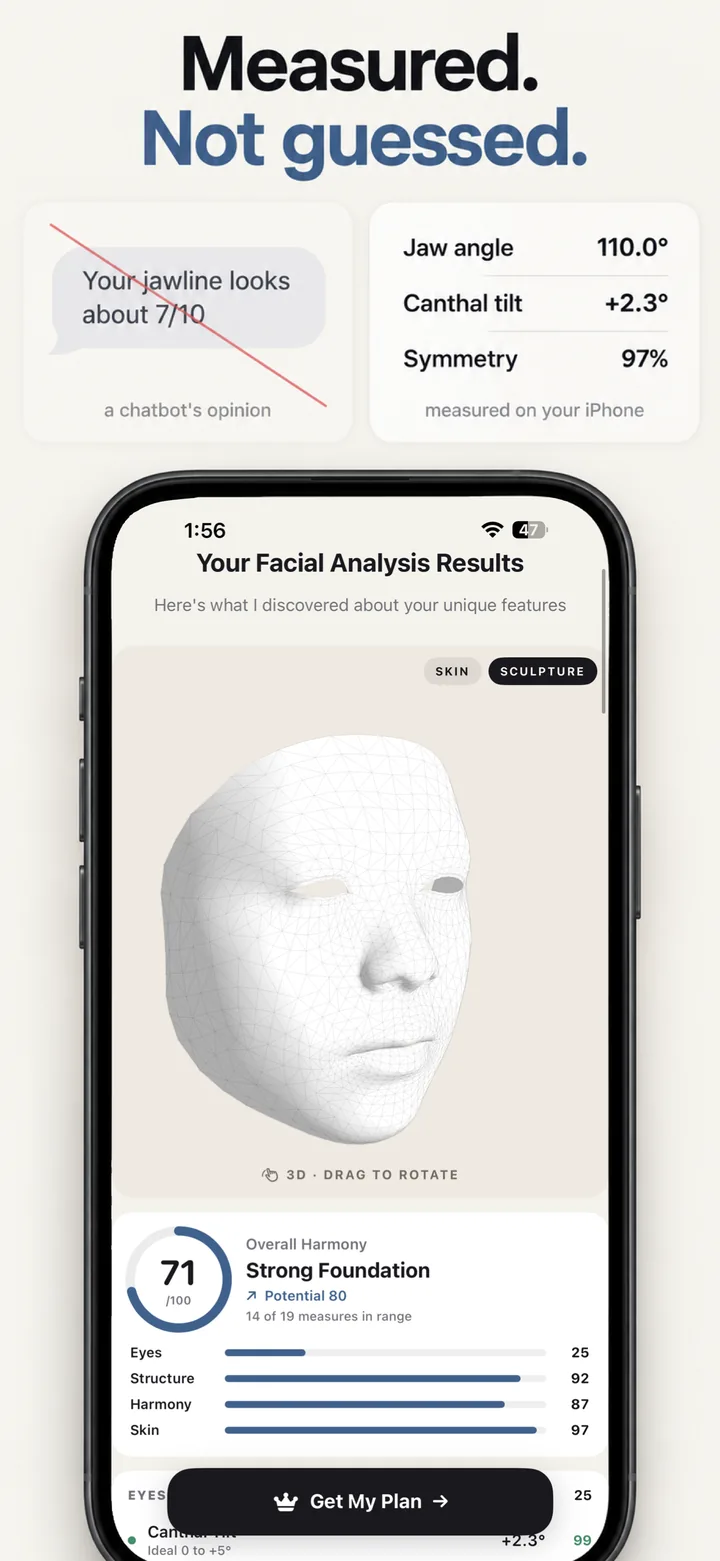
The symmetry tool reads chin offset from the facial midline in millimetres, along with eye, brow and mouth-corner differences. A chin offset under 6 mm is below the point at which ordinary observers notice it. Where the asymmetry is, and how much of it is chin versus mouth corner, is worth knowing before a consultation, because it is the difference between a straightforward orthodontic case and a surgical one.
Sources
Crossbite prevalence and condylar asymmetry: PMC9688623; 3D scan of 78 crossbite children: PMC8793659. Batista KB et al., Cochrane Database of Systematic Reviews 2018;3:CD003452. Post-retention stability: Little RM, Seminars in Orthodontics 1999;5(3):191-204; retainer compliance: Lim ME et al., BDJ Open 2023;9:10. Perception thresholds: Wang TT et al., Aesthetic Surgery Journal 2017;37(4):375-385.