
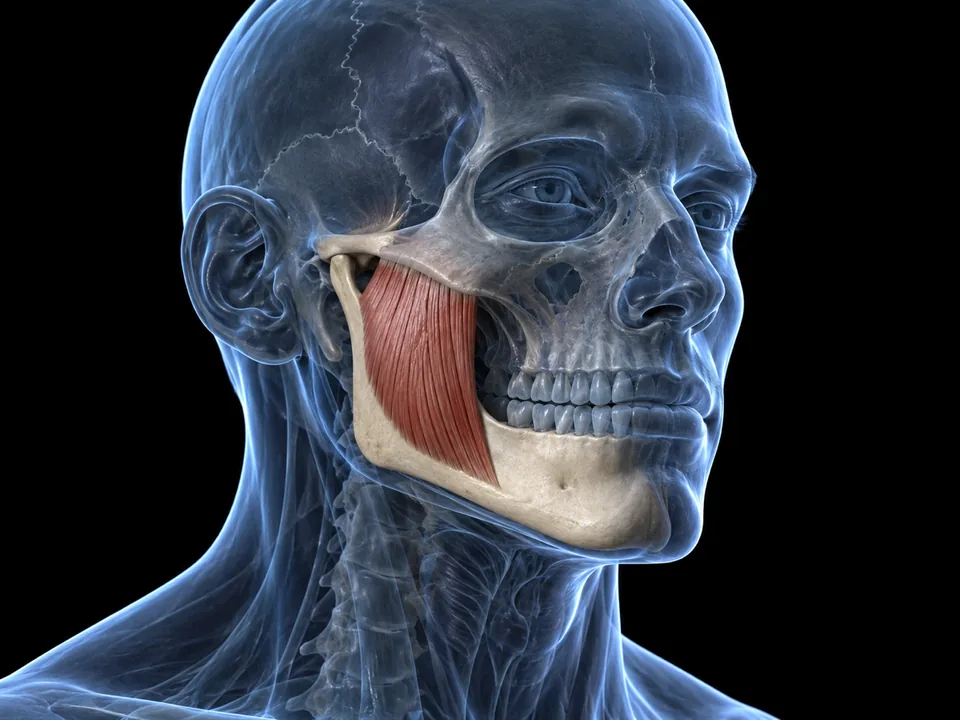
Mewing is the claim that resting your tongue on the roof of your mouth will, over months and years, reshape your jaw and cheekbones. It has billions of views. It also has something rarer than weak evidence: none.
Measure yours · freeJawline TestJaw angle, jaw width ratio, chin offset, chin height. About 30 seconds from one photo.Try it →What the literature contains
Search PubMed for "mewing OR orthotropics" and you get 31 results. Almost all of them are commentaries by or about the technique's originator, letters in response, or unrelated papers where "mewing" refers to a cat-cry syndrome. There is no randomised trial, no cohort study and no systematic review that tests it. The closest thing is a 2025 systematic review of facial exercise techniques that screened 10,370 records and noted a paucity of literature evaluating the efficacy of mewing.
That is not a technique with mixed results. It is a technique that has never been tested.
The part that should end the argument
If a resting tongue could move bone, a purpose-built appliance should do it better. That has been tested, at scale. A Cochrane review pooled 27 randomised trials with 1,251 children and adolescents. In the trials that started functional appliances early, around ages 7 to 11 while the jaw is still growing, and compared them with children who began treatment later, the final skeletal outcome, the ANB angle that describes how the upper and lower jaw relate, differed by 0.02 degrees on average once both groups had finished, with a confidence interval of minus 0.47 to plus 0.43. Against other appliances, the Twin Block improved it by 0.56 degrees. The largest effect in the review, about 2.4 degrees for removable appliances against no treatment, came from two small, low-quality trials.
Growing children, hard plastic, daily wear, and the jaw relationship moved by a few degrees at most. A tongue is not going to beat a Twin Block.
The advice that points the wrong way
A popular refinement says to push the tongue toward your weaker side to correct asymmetry. The entire evidence base for asymmetric tongue posture is one 2011 study of 12 people, and it found lower tongue pressure on the deviated side, which is more likely a consequence of the asymmetry than a cause of it. The advice has the arrow backwards.
What tongue posture is actually good for
None of this means the habit is worthless. Tongue on the palate, lips closed, breathing through the nose is the posture that goes with nasal breathing and a relaxed jaw, and those are real, everyday things you can feel. Symmi includes it as a habit for exactly that reason, and labels it honestly: a resting posture, not a bone remodelling program.
The jaw readings that mewing promises to change, jaw width, chin height, the mandible itself, are tagged structural in Symmi's report. They do not move with training, and the app says so on the reading. What does move is the soft tissue in front of the bone: the masseter (which six months of gum chewing did not grow either), the fat and fluid under the chin, and the head posture that decides how sharp the edge reads. That is where the plan spends its time.
Sources
- PubMed search for "mewing OR orthotropics". PubMed search — 31 results when this article was written (33 on 18 October 2026), almost none of them studies of the technique.
- Seraj SS, Moses O, Kamel Y, et al. Efficacy of conservative techniques for mechanical facial rejuvenation: a systematic review. Aesthetic Surgery Journal Open Forum, 2025. PubMed 41322034 — 12 small studies of facial exercises, myofunctional therapy and massage; evidence insufficient to establish efficacy, and mewing itself largely untested.
- Batista KB, Thiruvenkatachari B, Harrison JE, et al. Orthodontic treatment for prominent upper front teeth (Class II malocclusion) in children and adolescents. Cochrane Database of Systematic Reviews, 2018. PubMed 29534303 — 27 randomised trials, 1,251 participants; starting functional appliances early rather than later left the final ANB jaw angle 0.02 degrees different, and other comparisons moved it by up to about 2 degrees in small, low-quality trials.
- Takada J, Ono T, Miyamoto JJ, et al. Association between intraoral pressure and molar position and inclination in subjects with facial asymmetry. European Journal of Orthodontics, 2011. PubMed 20829312 — in 12 adults with facial asymmetry, tongue pressure was lower on the side the jaw had shifted toward.