
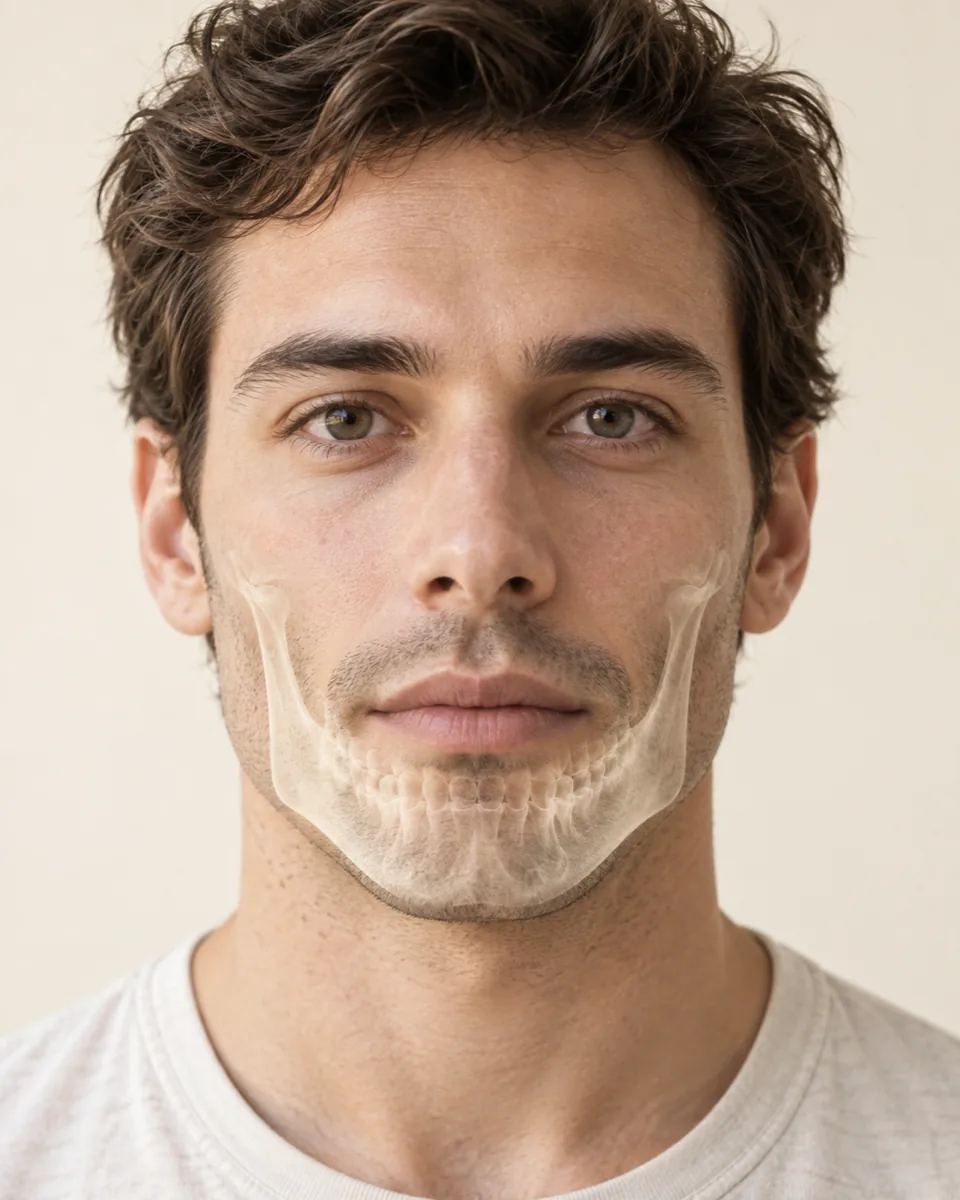
Verdict: works, for showing the border. Fat under the chin and along the jaw is the single biggest reason a jawline disappears, and it is the one layer that reliably responds to what you do. Losing it reveals the mandible underneath. It does not change the mandible.
Why fat is the layer that matters
A jawline is an edge: the place where the lower border of the mandible turns into the neck. Whether that edge is visible depends on what sits on top of it. Bone is fixed in adults. The masseter, over the back of the jaw, barely moves with training (six months of daily gum chewing did not thicken it). Fluid swings by the hour. Fat is the layer in between: it changes over weeks and months, and it changes a lot.
The submental fat pad, under the chin, is the one that decides whether there is a visible angle between chin and neck. The jowl fat, either side of the chin along the jaw, is the one that decides whether the border reads as a line or a curve. Both shrink when body fat drops. Both grow when it rises. No other lever on this list moves as much tissue.
What you will see, in order
People who lose a meaningful amount of weight usually notice the face before the waistband, and the jaw before the cheeks. The sequence is roughly:
- The chin-to-neck angle opens up. This is submental fat leaving, and it is the first visible change.
- The jaw border straightens. The jowl curve flattens into a line from chin to ear.
- The angle at the back of the jaw shows. This comes last and depends most on the bone you have.
The third step is where expectations go wrong. A face with a naturally soft mandibular angle, or a short ramus, will not develop a square corner by losing weight. The bone was always that shape; the fat was hiding it. Weight loss is a reveal, not a redesign.
What it does to symmetry
Weight loss reduces fat on both sides, so it does not create or correct asymmetry in the bone. But it does change what you notice. Under a layer of fat, a 4 mm difference in jaw-angle position is invisible. On a lean face it can show. The jaw angle is already the most asymmetric point on a normal face, 4.6 mm of left-right difference on average in a 3D study of 48 adults with normal bites. Some people who lean out for the first time see that difference for the first time and assume the diet caused it. It did not. It uncovered it.
The threshold for anyone else noticing is still about 6 mm at the chin. Most uncovered asymmetries stay well under it.
Two things that look like weight loss and are not
Water. A low-salt, low-alcohol week de-puffs the face and the jaw sharpens noticeably. This is fluid, not fat, and it comes back with the next salty meal. Gua sha and cold do the same thing, faster and for a shorter time.
Posture. A head carried forward drops the chin toward the neck and folds the submental skin. Pulling the head back over the shoulders opens the angle instantly. This is why the same person can have a jawline standing and none sitting at a laptop. It is also why before-and-after photos taken with the chin in different positions prove nothing.
Honest limits
- Bone does not change. The width of the jaw, the shape of the angle and the height of the chin are set.
- Skin has a limit. After large or rapid loss, especially later in life, the skin that covered the fat may not retract fully, and the edge can read soft for a different reason.
- Very low body fat is not the same as a better jaw. Below a certain point the face reads gaunt, the cheeks hollow, and the jaw looks harder but the whole face looks older. The usable range is wide but it is a range.
- Where the fat leaves first is not up to you. Some faces lean out early, some last.
Measure it instead of squinting at it
Fat loss is slow enough that the mirror cannot see it week to week. A number can. The jawline tool reads jaw angle, jaw width ratio, chin offset and chin height from a front photo. Take one now under plain front light at a fixed distance, then repeat monthly under the same conditions. The angle and chin offset should stay put, because they are bone. The width ratio is the one that moves as the soft tissue over the jaw thins, and it is the honest record of whether the diet is reaching your face.
Do not measure from a selfie held at arm's length. A phone at 12 inches widens the base of the nose by about 30% and rounds the whole lower face; a small change in distance will swamp a real change in fat.
Sources
3D soft-tissue asymmetry in 48 adults: PMC3481973. Perception thresholds: Wang TT et al., Aesthetic Surgery Journal 2017;37(4):375-385. Gum chewing and masseter thickness: Jung JH et al., Journal of Oral Rehabilitation 2024;51(12), doi:10.1111/joor.13830. Selfie distance: Ward B et al., JAMA Facial Plastic Surgery 2018;20(4):333-335. No controlled trial isolating body-weight change on jaw contour was found; the account above is anatomical.