
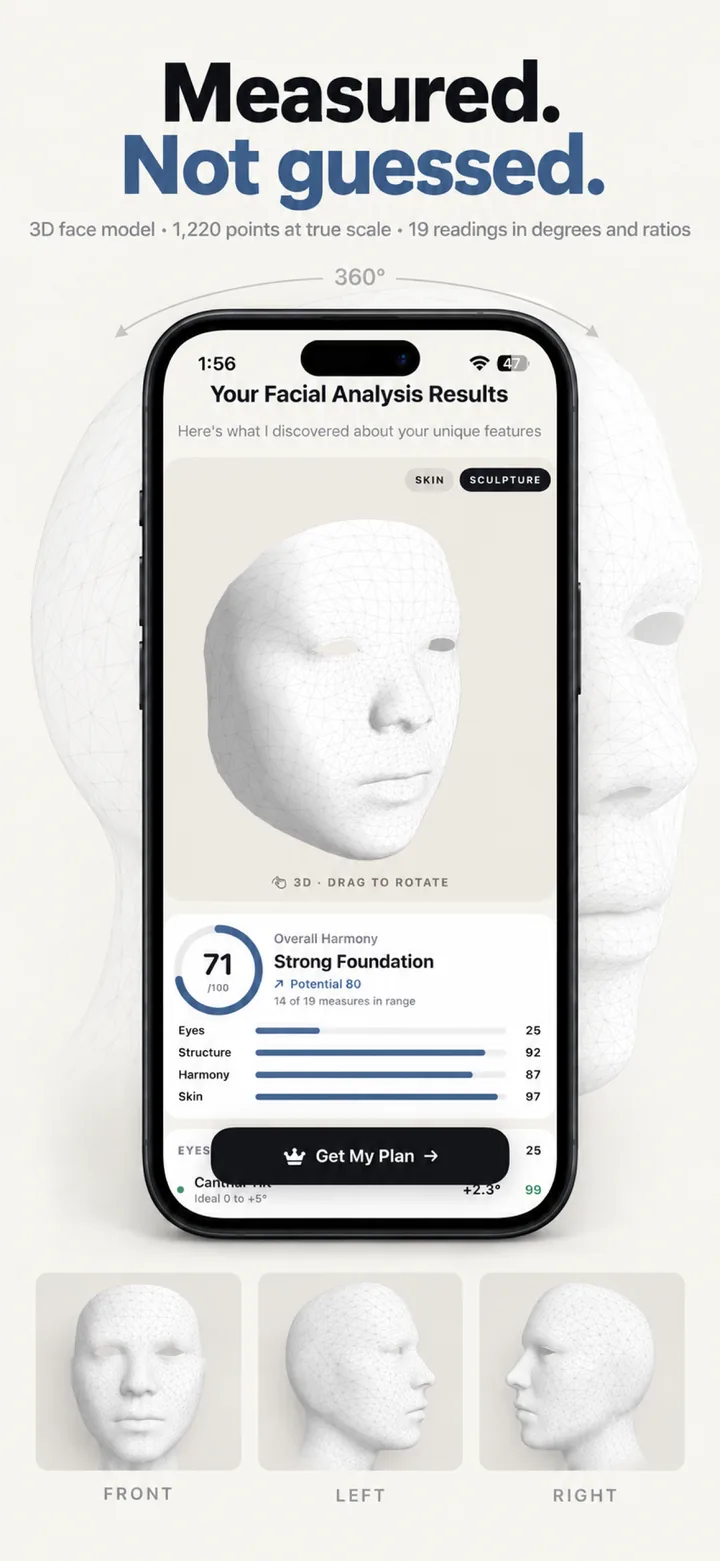
Verdict: changes the look, not the face. A beard adds nothing to the bone and covers a 2 to 3 mm jaw difference completely, because the edge people see becomes the edge of the hair. This is craft. There is one measurable fact in it: you can check the result with the jawline tool.
The jaw is the most asymmetric part of the face
In a 3D scan of 48 adults with normal bites, the chin and jaw angle differed left to right by 4.6 mm on average, the largest difference of 27 landmarks measured. The cheekbones came next at 3.3 mm. The pattern is simple: the lower and further out a landmark is, the less symmetric it is. Nobody has an even jaw. The threshold at which other people notice a chin off centre is about 6 mm.
A beard sits exactly on that region. That is why it works: it replaces the most asymmetric outline on the face with one you trim.
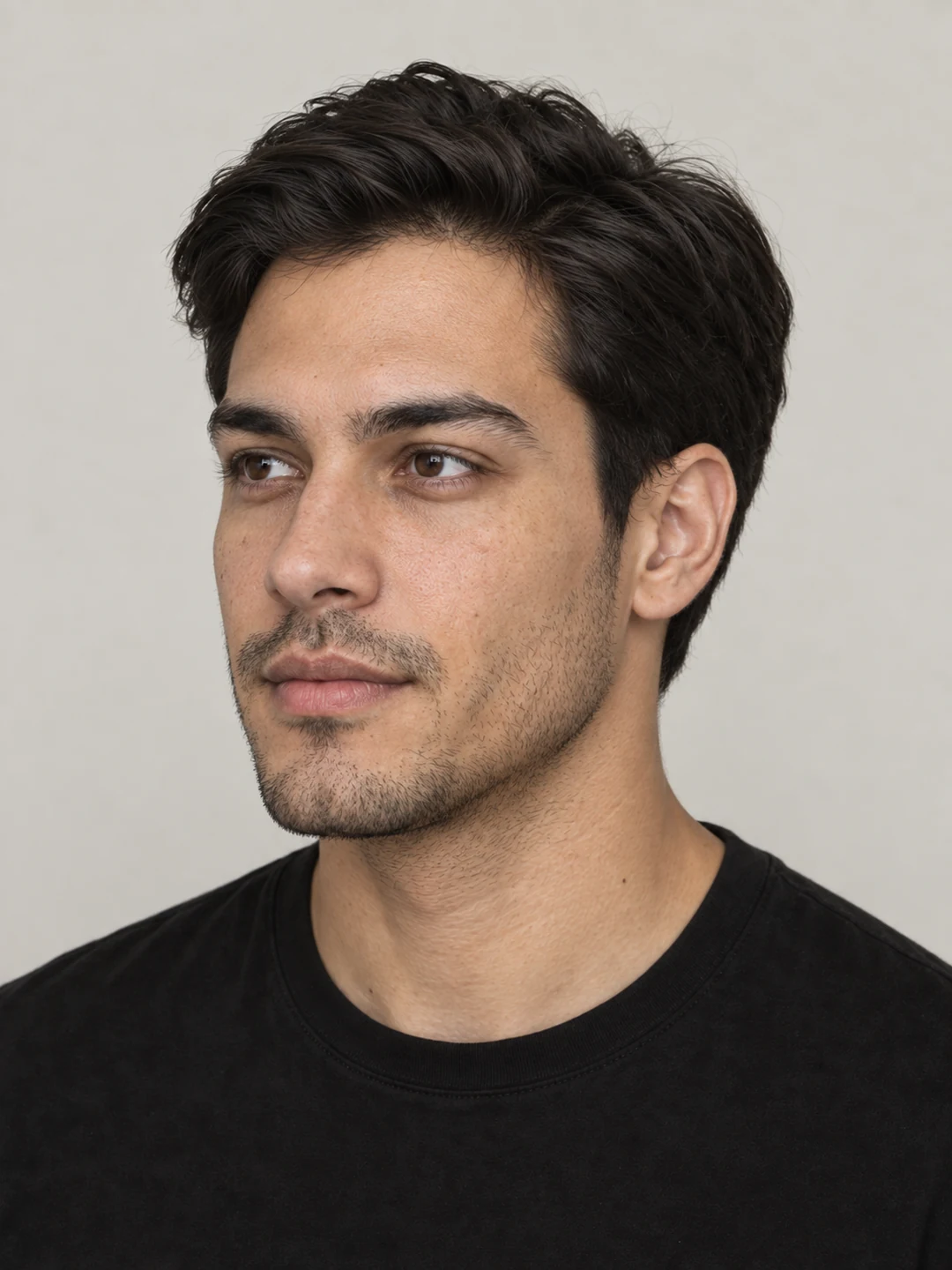
The neckline
The neckline is the line that decides where the jaw appears to end. Set it too high, above the natural jaw, and the beard looks like a chinstrap and the jaw looks short. Set it too low, down the neck, and the jaw disappears into the beard and the face reads heavy.
The standard is a line about a finger's width above the Adam's apple, curving up to just behind the jaw angle on each side. Now the asymmetry part: if one jaw angle sits lower than the other, do not follow the bone. Draw the neckline level. The beard fills the difference on the high side and the two sides read the same from the front. You are drawing the jaw you want, and at 2 to 3 mm of difference nobody will find the seam.
The cheek line
The cheek line sets the top edge and the apparent height of the cheekbone. A natural, slightly untidy cheek line is the safest. A hard, shaved cheek line is a horizontal reference that invites comparison, and if your cheekbones are 3 mm apart in height, a hard line will show it. If you want a clean line, set both to the same height above the mouth corner, not to the same distance below each cheekbone.
Fade heights
A fade on the sides of the beard, from full at the chin to short at the sideburn, controls how wide the lower face looks. The trick for a fuller side is to fade it slightly higher and tighter, and to leave the slimmer side slightly fuller and lower. A millimetre or two of guard length is enough; the aim is a balanced outline, not two different beards.
The same goes for the jaw angle. If one angle is softer or further back, keep the beard fuller there so the outline turns the corner where it should. If one angle is sharper, take it down a fraction so it does not read as the bigger side.
Length and the chin
Chin length is the cheapest way to add or move chin. A longer chin section extends the face downward and draws attention to the centre; a shorter one lets the jaw width read. If your chin sits off the midline, a slightly squared, symmetrical chin shape in the beard puts a new centre on the face, and the eye takes the beard's centre as the chin's.
A goatee or a defined chin patch does the opposite: it outlines the chin exactly, so any offset shows. Fuller coverage is more forgiving.
What a beard cannot do
It cannot change the jaw angle in degrees, the jaw width ratio or the chin height, because those are bone. What it can do is hide them, which for most people is the goal. It also cannot help a soft jaw caused by submental fat as much as people hope: a beard over a full neck reads as a full neck with a beard on it. For that layer, losing weight is the lever, and the beard is the finish.
The check
The jawline tool reads jaw angle, jaw width ratio, chin offset and chin height from a front photo, using the landmarks under the beard. Run it clean-shaven or with a short beard for a baseline; the readings are the face. Then trim, photograph in the same light, and look at the outline instead of the numbers. If the readings say 4 mm of chin offset and the outline reads level, the beard is doing its job.
Sources
3D soft-tissue asymmetry in 48 adults, 27 landmarks: PMC3481973. Perception thresholds: Wang TT et al., Aesthetic Surgery Journal 2017;37(4):375-385. Styling guidance is craft, not a study.