
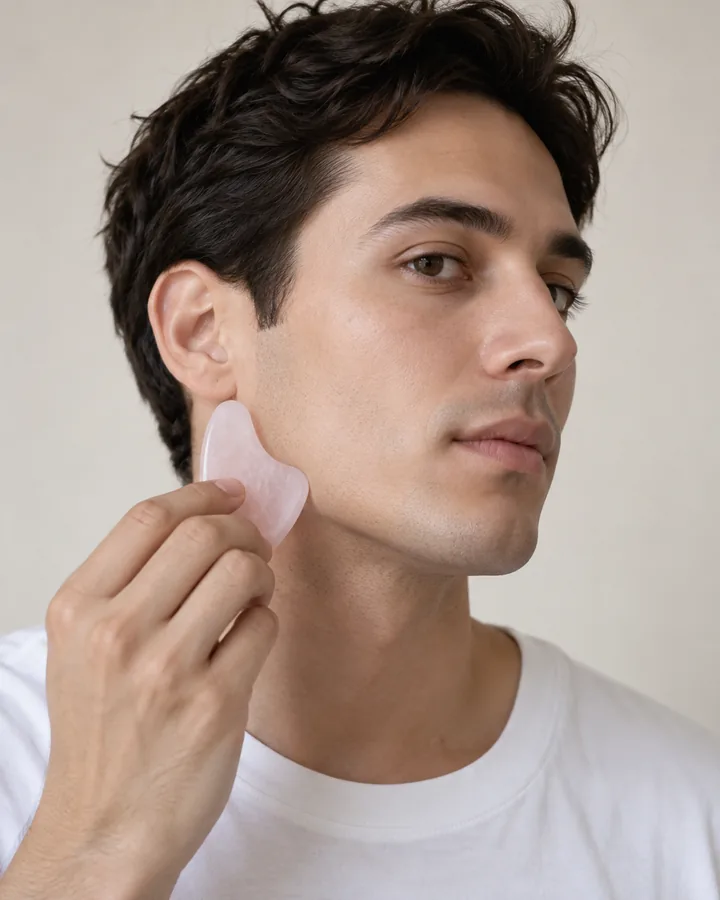
Verdict: changes the look, not the face. Gua sha along the jaw shifts fluid out of the tissue and the edge reads sharper for a few hours. There is no controlled trial showing it changes the masseter, the fat pad or the mandible, and it would be surprising if it did.
Measure yours · freeJawline TestJaw angle, jaw width ratio, chin offset, chin height. About 30 seconds from one photo.Try it →Three layers, one of which moves
What you see as a jawline is the mandible, the masseter over its back half, a layer of fat and fluid over both, and the skin. Bone does not move in adults. The masseter is stubborn: six months of daily gum chewing did not thicken it, and a lifetime of one-sided chewing leaves about 1 mm of difference. The fat pad changes with body weight, slowly.
The fluid is the one layer that changes by the hour. Overnight, lying flat, fluid pools in the face; through the morning it drains and the edge of the jaw reappears. Salt, alcohol, a late night and crying all put it back. That daily swing is the effect gua sha works on, and it is why the same face can look soft at 7 am and defined at noon without anything structural changing.
What a stone can do
Stroking from the chin along the jaw toward the ear, then down the neck, follows the direction lymph drains. The idea is that light pressure and repetition move fluid faster than waiting does, though this has not been measured on the jaw. The visible result is a slightly sharper edge under the jaw and a slightly slimmer lower face, for a few hours. Cold does the same thing by a different route, constricting vessels so less fluid sits in the tissue.
That is the whole mechanism. It is real, it is quick, and it wears off. If you do it every morning you get the sharper version of your face every morning, which for a lot of people is exactly the point.
What a stone cannot do
- It cannot reach the mandible. The jaw angle is the most asymmetric point on a normal face, 4.6 mm of left-right difference in a 3D study of 48 adults, and it is bone.
- It cannot shrink the masseter. The one thing that does that quickly is botulinum toxin, a clinic procedure.
- It cannot remove fat. Pressure on a fat pad moves it for a moment and it settles back.
- It cannot "release" a jaw into a new shape. The tissue you are pressing on has no memory of the stroke by the evening.
We looked for a controlled trial of gua sha on jaw contour, masseter thickness or facial asymmetry and did not find one. That is not evidence it fails. It is evidence that the claim has never been tested, and a claim that has never been tested should be sold as what it is: a de-puffing routine.
Why the before-and-after photos look so good
Most gua sha transformations online are taken in the morning, before and after, in the same session. The before is the puffy face; the after is the drained face. Both are true. The thing missing is a third photo taken that evening, or a week later, which would look like the first one.
Add the usual photography effects and the difference grows. A phone held at arm's length widens the base of the nose by about 30% and softens the jaw; a photo taken from further back with the chin slightly forward sharpens it. Many before-and-afters change the distance without meaning to.
The routine, honestly labelled
The app includes a gua sha routine, along the jaw and down the neck, followed by a two-minute cold pass. It is filed under de-puffing, with the readings it can affect tagged as soft tissue, and it sits next to the posture drills that stop the head creeping forward, because forward head posture buries a jawline faster than any fluid does. It is not filed under structure, and the app says so on the reading.
If you want to see how much of your own jawline is fluid, the test is free. Run the jawline tool on a photo taken the moment you wake up, then again at noon, same light, same distance. The jaw angle will not move. The width reading may. That gap is the size of the effect gua sha is working with, and it is the honest limit of what a stone can do.
Sources
- Jung HJ, Hwangbo NK, Park Y, et al. Effects of gum chewing training on occlusal force, masseter muscle thickness and mandibular shape: A randomised controlled clinical trial. Journal of Oral Rehabilitation, 2024. PubMed 39215439 — 58 adults randomised; chewing gum three times a day for six months raised bite force through a larger tooth contact area but did not change masseter thickness or mandibular shape.
- Dogan ME, Şahin N. Ultrasonographic assessment of the effects of unilateral mastication on the temporal and masseter muscles. The Journal of Prosthetic Dentistry, 2026. PubMed 41038728 — ultrasound in 25 habitual one-side chewers; the masseter measured 12.2 mm at rest and 14.6 mm clenched on the chewing side versus 11.3 mm and 13.6 mm on the other side.
- Hwang HS, Yuan D, Jeong KH, et al. Three-dimensional soft tissue analysis for the evaluation of facial asymmetry in normal occlusion individuals. Korean Journal of Orthodontics, 2012. PubMed 23112933 — CT-based 3D study of 48 adults with normal bites; left-right differences ranged from 0.6–0.7 mm on midline nose and forehead landmarks to 3.3 mm at the cheekbone and 4.6 mm at the jaw angle.
- Ward B, Ward M, Fried O, et al. Nasal Distortion in Short-Distance Photographs: The Selfie Effect. JAMA Facial Plastic Surgery, 2018. PubMed 29494735 — geometric model of camera distance; at about 12 inches the base of the nose appears roughly 30% wider relative to the cheekbones than at 5 feet.