
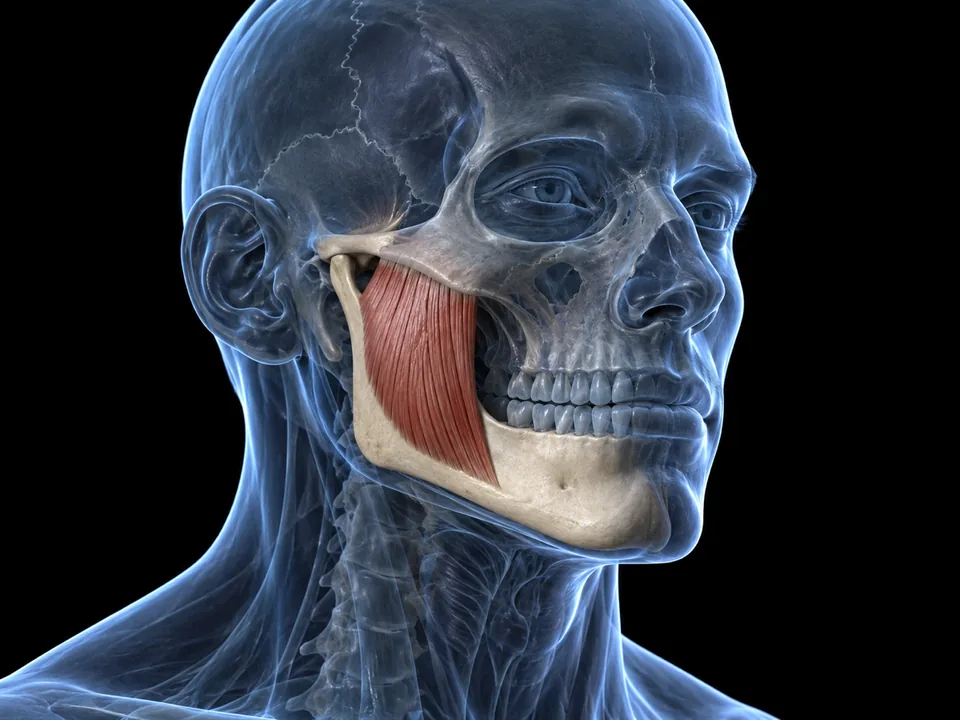
Verdict: works a little, and only in the muscle layer. A lifetime of chewing on one side leaves the masseter on that side about 1 mm thicker. Chewing evenly can close that gap. It does not touch the bone underneath, and the bone is where most visible asymmetry lives.
The number
Ultrasound on habitual one-side chewers gives the cleanest measurement. On the chewing side the masseter measured 12.2 mm at rest and 14.6 mm clenched; on the other side, 11.3 mm and 13.6 mm. The difference is about 1 mm. People with an asymmetric masseter were far more likely to have the habit (66.7% versus 20% of people with symmetric muscles), so the link is real. It is also small, and the study was cross-sectional, so it shows association rather than proof of cause.
One more thing from the same literature: in 22 healthy young adults, surface EMG showed the two masseters firing with only 66 to 74% symmetry. Nobody chews evenly. An uneven face is the default, not a sign you did something wrong.
Which side is actually bigger
Here is where the internet advice falls apart. Every forum thread says the chewing side is the bigger side, so chew on the small side to fix it. Two of the best data sets disagree with that, and with each other.
A 3D scan study of 106 same-sex twin pairs found chin volume larger on the side opposite the habitual chewing side, the reverse of intuition. The largest cohort, 748 adults from the Northern Finland 1986 birth cohort scanned at age 34, found no statistically significant effect of chewing preference on facial asymmetry at all. In that group 42.4% chewed mostly right, 44.1% both sides and 13.5% mostly left.
So the honest position is: the masseter is about 1 mm thicker on the chewing side, and whether that translates into a visibly bigger side of the face is contested by the largest study that looked. People who report "I chewed on my weak side for a year and nothing changed" are not doing it wrong. They are running an experiment the literature already ran.
What the muscle can and cannot do
The masseter is a thick, strong muscle, but it is remarkably resistant to training. In a randomised trial at Yonsei University, 58 adults chewed gum three times a day for six months. Bite force went up, but masseter thickness and jaw shape did not change. Six months of daily chewing did not grow the muscle, so a few weeks of switching sides will not shrink it either.
For scale, the only thing that moves the masseter fast is a clinic: botulinum toxin reduces its thickness by roughly a quarter to a third within three months. That is a 3 to 4 mm change against the 1 mm that chewing produces over a lifetime.
Under the muscle sits the mandible, and this is where the asymmetry you notice mostly comes from. In a 3D scan of 48 adults with normal bites, the jaw angle differed left to right by 4.6 mm on average, the most asymmetric point on the face. Chewing does not reach it.
What "chew evenly" is good for
- Stopping the gap from widening. If one masseter is thicker and you keep loading it, you keep the difference. Alternating sides holds it level.
- Jaw comfort. One-sided chewing loads one temporomandibular joint more than the other. The two joints cannot move independently, so the imbalance is felt on both sides.
- Not much else. It is a maintenance habit, not a correction.
How to know which layer your asymmetry is in
Clench hard and press a fingertip into each jaw angle. If one side bulges more, that is muscle, and evening out your chewing is a reasonable long-term habit. Then relax completely and feel the bone under the same fingertips. If one corner sits lower or further back, that is mandible, and no chewing pattern will move it.
The jawline tool reads jaw angle, jaw width ratio and chin offset from a front photo. Take it once now and once in three months under the same light. If the chin offset and jaw angle are unchanged and only the width reading moves, you have just measured the difference between muscle and bone on your own face.
Sources
Masseter ultrasound: Journal of Prosthetic Dentistry 2025; Rajesh K et al., Cureus 2024;16(3):e56849; PMC11860558. Twin study: Heikkinen EV et al., Acta Odontologica Scandinavica 2022;80(3):197-202. Northern Finland Birth Cohort 1986: Acta Odontologica Scandinavica 2024, PMC11423695. Gum trial: Jung JH et al., Journal of Oral Rehabilitation 2024;51(12), doi:10.1111/joor.13830. 3D asymmetry in 48 adults: PMC3481973.