
"Symmetry is beauty" is repeated so often it sounds like physics. When researchers measured it, the relationship almost vanished.
Measure yours · freeFace Symmetry TestSymmetry index plus eight left-right readings. About 30 seconds from one photo.Try it →The meta-analysis
A 2005 review pooled 13 studies that measured facial asymmetry with instruments and compared it with attractiveness ratings. In men, the weighted correlation was r = -0.14, meaning asymmetry explains about 2% of the variation in how attractive a face is rated. In women it was essentially zero. Every other factor in a face, skin, proportions, expression, averageness, mattered more.
The story got stranger when researchers built perfectly symmetric faces. Made the crude way, by mirroring one half of a face onto the other, the symmetric version was rated less attractive than the original. Made the careful way, by blending left and right, symmetry helped a little. The 2006 review that untangled this concluded the effect is real but small, and depends entirely on how you manufacture it.
Where the "good genes" story came from
The idea that symmetry signals health traces to a 1993 paper proposing that symmetric bodies reflect resistance to parasites. It was a hypothesis. When a large cohort finally tested it, 4,732 adolescents laser-scanned in 3D at 21 landmarks and compared with twelve years of annual health records, facial asymmetry correlated with total infection burden at r = -0.021 and with the proportion of years spent ill at r = 0.002. Neither was distinguishable from zero.
A quick test
Take a front-on photo of yourself and mirror the left half to make a whole face. Then do the same with the right half. You get two strangers, and most people find both less appealing than their actual, asymmetric face.
Why measure symmetry at all
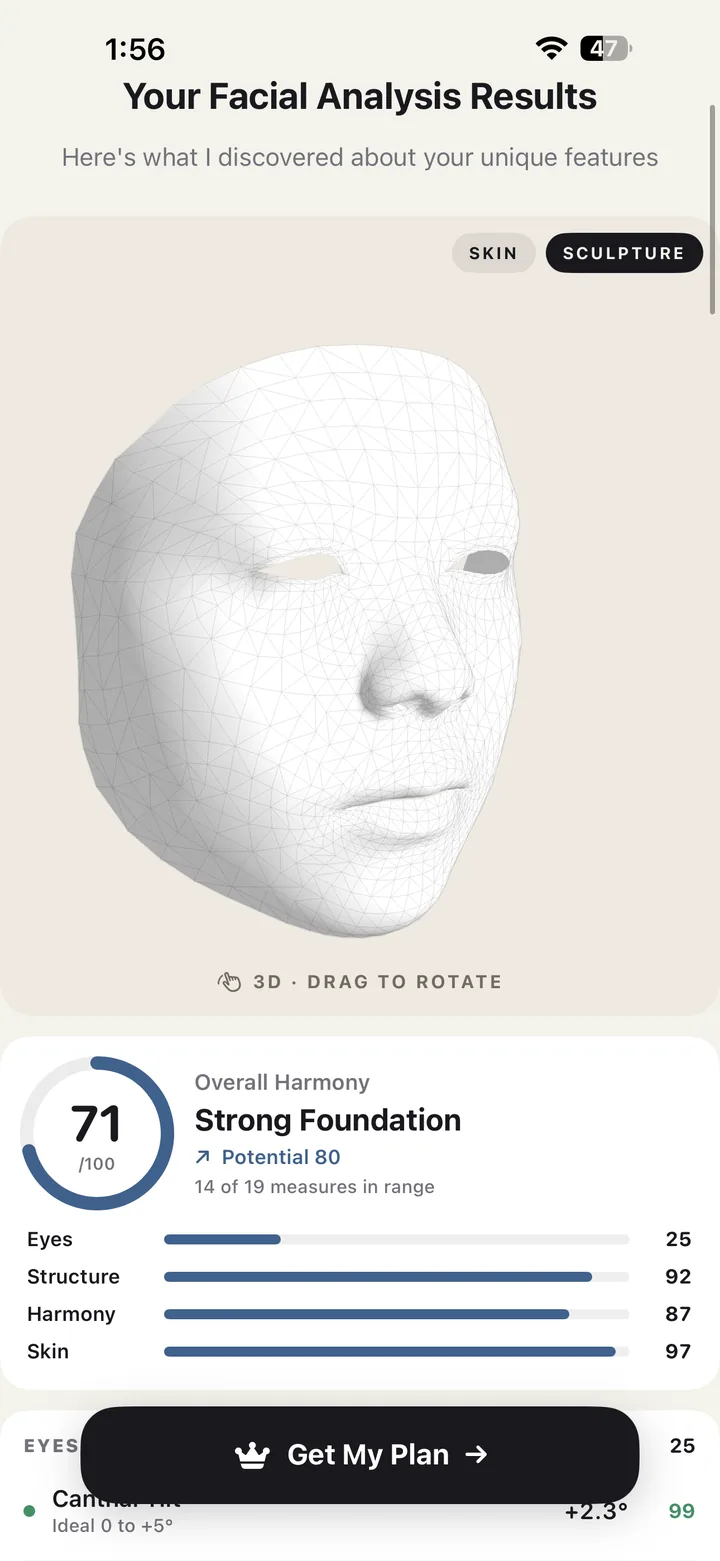
Because the search is not really about being perfectly symmetric. It is about the specific feeling that one brow, one eye or the chin sits somewhere it should not, not being able to say by how much, and not knowing whether anyone else can see it. Symmi measures 13 left-right markers and reports each as a number against a normal range, alongside 19 proportion readings that have far more to do with how a face reads than mirror-image perfection does: canthal tilt, midface ratio, jaw width, lower third.
It is not a symmetry score to chase to 100. It is a map of where your face leans, with each reading tagged as bone, which stays, or muscle, fluid and posture, which you can work on. The plan is built from the second group only.
Sources
- Weeden J, Sabini J. Physical attractiveness and health in Western societies: a review. Psychological Bulletin, 2005. PubMed 16187849 — reviewed the evidence that cues such as symmetry predict attractiveness and health; symmetry failed to predict either reliably.
- Rhodes G. The evolutionary psychology of facial beauty. Annual Review of Psychology, 2006. PubMed 16318594 — reviews averageness, symmetry and sexual dimorphism, including how symmetric test faces are made.
- Thornhill R, Gangestad SW. Human facial beauty: averageness, symmetry, and parasite resistance. Human Nature, 1993. PubMed 24214366 — the paper that proposed facial symmetry as a signal of parasite resistance.
- Pound N, Lawson DW, Toma AM, et al. Facial fluctuating asymmetry is not associated with childhood ill-health in a large British cohort study. Proceedings of the Royal Society B, 2014. PubMed 25122232 — 3D face scans of 4,732 teenagers showed no link between facial asymmetry and childhood health records.