
Free tool · runs in your browser
Nose to Mouth Ratio Calculator
The nose to mouth ratio is your mouth width divided by your nose width. Looksmax forums put the ideal at 1.5 to 1.62, and the classical canon says the mouth is one and a half noses wide. Upload a straight-on photo and Symmi measures both widths in millimetres, draws them on your face, and adds the two classical nose checks: nose against the gap between your eyes, and nose against your cheekbones.
Drop a photo, paste one, or choose a file
Straight-on, whole face visible, even light. JPG, PNG or WebP.
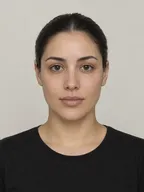
Runs in your browser. Your photo never leaves your device.
How it is measured
Mouth width over nose width.
Mouth width runs corner to corner; nose width runs across the outer edges of the nostril wings. Both come from the 478 face landmarks after removing head tilt, and your iris (about 11.7 mm across in adults) is the ruler for the millimetres. The landmark mouth corners sit slightly inside the visible corners, so photo ratios run lower than numbers measured with a tape on a real face: most faces read 1.28–1.48 here. Compare your result with this band rather than with the forum figure.
- Mouth ÷ nose
- The main reading. Under 1.28 a compact mouth for the nose, 1.28–1.48 balanced, over 1.48 a wide mouth.
- Mouth and nose width
- Both in millimetres, measured with your iris as the ruler (±5%).
- Nose ÷ eye gap
- Nose width over the gap between the inner eye corners. The classical canon says 1.0.
- Nose ÷ cheekbones
- Nose width over cheekbone width. The forum rule of thumb is under 0.29.
Measure it yourself
How to measure your nose to mouth ratio by hand
You need one straight-on photo with the mouth closed and relaxed, and a ruler or a photo editor that shows pixel positions.
- 1Take the photo straight on at eye level from at least an arm's length, neutral face, lips together. A smile widens the mouth.
- 2Mouth width: measure straight across from one mouth corner to the other.
- 3Nose width: measure straight across the widest part of the nostril wings.
- 4Divide mouth width by nose width. For example 50 mm ÷ 34 mm = 1.47. Pixels work too, since only the ratio counts.
- 5Or upload the photo above and both widths are measured and drawn for you.
Skip the ruler: the free tool above does it from one photo in about 30 seconds ↑
What's normal
What your nose to mouth ratio means
Bands for this tool's landmark set. Tape measurements on a real face run a little higher.
- Under 1.28
- Reads as: Compact mouth for the nose
- Note: The mouth is close to the nose in width. Common, and more common with broader noses.
- 1.28 – 1.48
- Reads as: Balanced
- Note: Where most faces sit on photos. The upper half of this band is closest to the forum ideal.
- Over 1.48
- Reads as: Wide mouth for the nose
- Note: The mouth is well over one and a half noses wide. Often read as a full, expressive mouth.
Nose width varies a lot with ancestry, so the ratio describes proportion, not attractiveness on its own.
Sources
What this is based on.
The measurement and its reference ranges come from published research. Studies use different methods and populations, so compare your number with the range shown on this page rather than with other tools.
- 1.
Farkas LG, Hreczko TA, Kolar JC, Munro IR (1985). Vertical and horizontal proportions of the face in young adult North American Caucasians: revision of neoclassical canons. Plastic and Reconstructive Surgery. PubMed 3883374
Tested the classical facial canons on real faces.
- 2.
Farkas LG, Katic MJ, Forrest CR, et al. (2005). International anthropometric study of facial morphology in various ethnic groups/races. Journal of Craniofacial Surgery. PubMed 16077306
Facial proportions measured across ethnic groups; normal ranges vary by population.
- 3.
Pallett PM, Link S, Lee K (2010). New "golden" ratios for facial beauty. Vision Research. PubMed 19896961
Which eye-spacing and eye–mouth ratios looked most attractive in experiments.
- 4.
Holland E (2008). Marquardt's Phi mask: pitfalls of relying on fashion models and the golden ratio to describe a beautiful face. Aesthetic Plastic Surgery. PubMed 18175168
Why a single 'ideal' ratio such as the golden ratio does not describe real faces.
- 5.
Kartynnik Y, Ablavatski A, Grishchenko I, Grundmann M (2019). Real-time facial surface geometry from monocular video on mobile GPUs. arXiv. arXiv:1907.06724
The face-mesh model that places the 468 surface landmarks this tool measures from.
- 6.
Ablavatski A, Vakunov A, Grishchenko I, et al. (2020). Real-time pupil tracking from monocular video for digital puppetry. arXiv. arXiv:2006.11341
The iris model that adds 10 eye landmarks (478 in total), used for pupil-based reference lines.
Our own data: how much each reading moves when the same face is photographed again is published on the methodology page. How we choose sources.
Related tools
Facial Ratios Calculator
The whole forum list, thirteen ratios from one photo.
Philtrum Length Calculator
Nose to lip distance in mm and the chin ratio.
Midface Ratio Calculator
Pupil span over pupil-to-lip height.
Golden Ratio Face Calculator
Five classical ratios against φ.
Nose Shape Test
Your nose type from a side photo.
Nose Job Simulator
A narrower nose on your own photo.
Lip Filler Simulator
Fuller lips on your own photo.
PSL Score Test
A measured 1–8 PSL rating with your tier.
FAQ
What is the ideal nose to mouth ratio?+
Looksmax forums quote 1.5 to 1.62 for mouth width over nose width, and the neoclassical canon says the mouth is 1.5 times the nose. Those are conventions measured on real faces, not research findings. On photo landmarks the same faces read lower, which is why this tool shows its own band, 1.28–1.48.
Is it the same as the nose to lip ratio?+
Usually, yes: people use both names for mouth width over nose width. Some mean the vertical distance from the nose to the lip instead, which is the philtrum. The Philtrum Length Calculator measures that one.
How wide should my mouth be?+
Adult mouths are typically about 45–55 mm wide at rest, and noses about 31–38 mm across the nostril wings. This tool gives both in millimetres, so you can compare.
Can I change my nose to mouth ratio?+
Not the bone or cartilage without surgery, but the photo changes it a lot: a close-up lens makes the nose look wider, and a smile makes the mouth wider. Take the photo at arm's length with a relaxed mouth for a fair reading. Lip liner and filler change the look of the lips, not their width.
Why does my result differ from a ruler on my face?+
The landmark mouth corners sit a little inside the visible corners, and a phone lens slightly widens whatever is closest to it, usually the nose. Both pull photo ratios lower than a tape measure.
Is my photo uploaded?+
No. The calculation runs in your browser.
One reading here.
Nineteen in the app.
A controlled scan, every reading against its ideal band, bone vs trainable, a plan, and a 3D model on Face ID iPhones.