
Free lip shape test · runs in your browser
What Lip Shape Do I Have?
Upload a straight-on photo with your lips closed and relaxed, and the detector names your lip shape: full, thin, heart-shaped, balanced, top-heavy, bottom-heavy, upturned, downturned or wide. It also gives your lip ratio (lower lip against upper lip, the 1:1.6 rule people quote), how defined your Cupid's bow is, which way your mouth corners point and your mouth width in millimetres.
Drop a photo, paste one, or choose a file
Straight-on, whole face visible, even light. JPG, PNG or WebP.
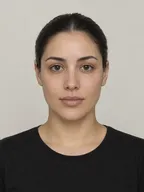
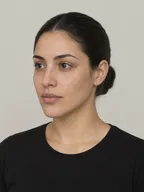
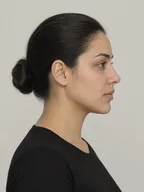
Runs in your browser. Your photo never leaves your device.
How it is measured
Five readings from the lips at rest.
The face landmarks trace the outline of both lips, the line where they meet and the two peaks of the Cupid's bow. From them the tool measures how tall the lips are for their width (fullness), the lower lip against the upper lip (the lip ratio), how deep the dip between the two bow peaks is, whether the mouth corners sit above or below the lip line, and the mouth width against the nose. Your shape is named after the trait that stands out most; the rest are listed underneath.
- Fullness
- Lip height ÷ mouth width. Under 0.28 thin, 0.28–0.37 medium, 0.37 and up full.
- Lip ratio
- Lower lip height ÷ upper lip height. The forum ideal is 1 : 1.6; 1 : 1.25–1.8 reads balanced.
- Cupid's bow
- The dip at the centre of the upper lip ÷ upper lip height. 28% and up reads as a defined, heart-shaped bow.
- Corners
- Corner height against the lip line: upturned, straight or downturned.
- Width
- Mouth width in mm with your iris as the ruler, and against your nose width.
What's normal
The lip shapes
- Heart-shaped
- What it means: A pronounced Cupid's bow with two clear peaks
- How it reads: Defined and doll-like.
- Full
- What it means: Tall lips for the width of the mouth
- How it reads: Soft, youthful, often called sensual.
- Thin
- What it means: Lips short in height for the mouth width
- How it reads: Neat and refined; liner and a lighter shade make them look fuller.
- Top-heavy / bottom-heavy
- What it means: Upper lip as full as or fuller than the lower, or the lower lip much fuller
- How it reads: The lip ratio shows which.
- Upturned / downturned
- What it means: Corners above or below the lip line at rest
- How it reads: Upturned reads friendly; downturned reads serious.
- Balanced
- What it means: Nothing stands out: medium fullness, balanced ratio, soft bow
- How it reads: The most versatile shape for lip colours.
Every lip shape has its own look. The result describes your lips in this photo, not how they should be.
Sources
What this is based on.
The measurement and its reference ranges come from published research. Studies use different methods and populations, so compare your number with the range shown on this page rather than with other tools.
- 1.
Farkas LG, Hreczko TA, Kolar JC, Munro IR (1985). Vertical and horizontal proportions of the face in young adult North American Caucasians: revision of neoclassical canons. Plastic and Reconstructive Surgery. PubMed 3883374
Tested the classical facial canons on real faces.
- 2.
Farkas LG, Katic MJ, Forrest CR, et al. (2005). International anthropometric study of facial morphology in various ethnic groups/races. Journal of Craniofacial Surgery. PubMed 16077306
Facial proportions measured across ethnic groups; normal ranges vary by population.
- 3.
Pallett PM, Link S, Lee K (2010). New "golden" ratios for facial beauty. Vision Research. PubMed 19896961
Which eye-spacing and eye–mouth ratios looked most attractive in experiments.
- 4.
Holland E (2008). Marquardt's Phi mask: pitfalls of relying on fashion models and the golden ratio to describe a beautiful face. Aesthetic Plastic Surgery. PubMed 18175168
Why a single 'ideal' ratio such as the golden ratio does not describe real faces.
- 5.
Kartynnik Y, Ablavatski A, Grishchenko I, Grundmann M (2019). Real-time facial surface geometry from monocular video on mobile GPUs. arXiv. arXiv:1907.06724
The face-mesh model that places the 468 surface landmarks this tool measures from.
- 6.
Ablavatski A, Vakunov A, Grishchenko I, et al. (2020). Real-time pupil tracking from monocular video for digital puppetry. arXiv. arXiv:2006.11341
The iris model that adds 10 eye landmarks (478 in total), used for pupil-based reference lines.
Our own data: how much each reading moves when the same face is photographed again is published on the methodology page. How we choose sources.
Related tools
Lip Filler Simulator
Fuller lips on your own photo.
Lipstick Try-On
14 lip shades on your own photo.
Nose to Mouth Ratio
Mouth width ÷ nose width, in mm.
Philtrum Length Calculator
Nose to lip distance and the chin ratio.
Smile Analysis
Smile symmetry, corner lift and width.
Facial Ratios Calculator
The whole forum list, thirteen ratios.
Cute or Hot Test
Full lips are one of the hot cues.
FAQ
What lip shape do I have?+
Upload a straight-on photo with your mouth closed and relaxed. The detector measures fullness, lip ratio, Cupid's bow and corner direction and names the trait that stands out most: heart-shaped, full, thin, top-heavy, bottom-heavy, upturned, downturned, wide or balanced.
What is the ideal lip ratio?+
The rule quoted most often is 1 : 1.6, the lower lip about 1.6 times as tall as the upper lip. It's a convention borrowed from the golden ratio, not a research finding. Anything from about 1 : 1.25 to 1 : 1.8 reads balanced.
What is a Cupid's bow?+
The double curve of the upper lip: two peaks under the philtrum with a dip between them. A deep dip and sharp peaks make a defined, heart-shaped bow; a shallow one makes a softer, straighter upper lip.
What are the different lip shapes?+
The common names are full, thin, heart-shaped, round, wide, top-heavy, bottom-heavy, bow-shaped, upturned and downturned. Most lips combine a few of these traits, which is why the tool lists all five readings.
Can I change my lip shape?+
Lip liner and colour change how the shape reads: a liner slightly outside the natural line on a thin lip, a darker shade on a fuller lip. Filler changes the volume; the Lip Filler Simulator shows the effect on your own photo.
Is my photo uploaded?+
No. Everything runs in your browser.
One reading here.
Nineteen in the app.
A controlled scan, every reading against its ideal band, bone vs trainable, a plan, and a 3D model on Face ID iPhones.