
Face shape guide
Oval face shape
An oval face is about one and a half times longer than it is wide, widest at the cheekbones, with a jaw a little narrower than the cheekbones and a softly rounded chin.
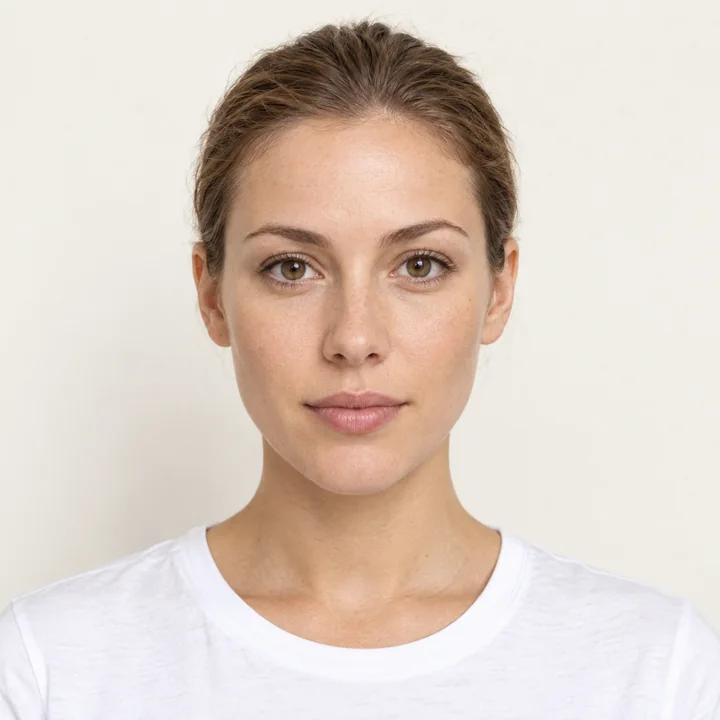
How to tell
- The face is noticeably longer than it is wide, but not long: roughly one and a half times.
- The cheekbones are the widest point; the forehead and the jaw are each a little narrower.
- The jawline curves down into the chin without a visible corner.
- The chin is rounded, neither pointed nor flat.
- The sides taper gently from cheek to chin rather than running straight.
What the detector scores
- Length : width
- 1.38 – 1.52 · half credit 1.34 – 1.56
- Jaw : face width
- 0.74 – 0.78 · half credit 0.72 – 0.80
- Jaw angle
- 108° – 116° · half credit 105° – 120°
Oval has no forehead or lower-jaw rule: it is defined by sitting in the middle on the three readings above. Bands are the ones the Face Shape Detector uses on uploaded photos; width is measured at the cheekbones, forehead at the temples, length from an estimated hairline to the chin.
Measure yours
Are you oval? Measure it.
Upload a straight-on photo. 478 landmarks, five readings, a score against all six shapes. Runs in your browser, nothing uploaded.
Often confused with
The two nearest shapes, and the number that separates them.
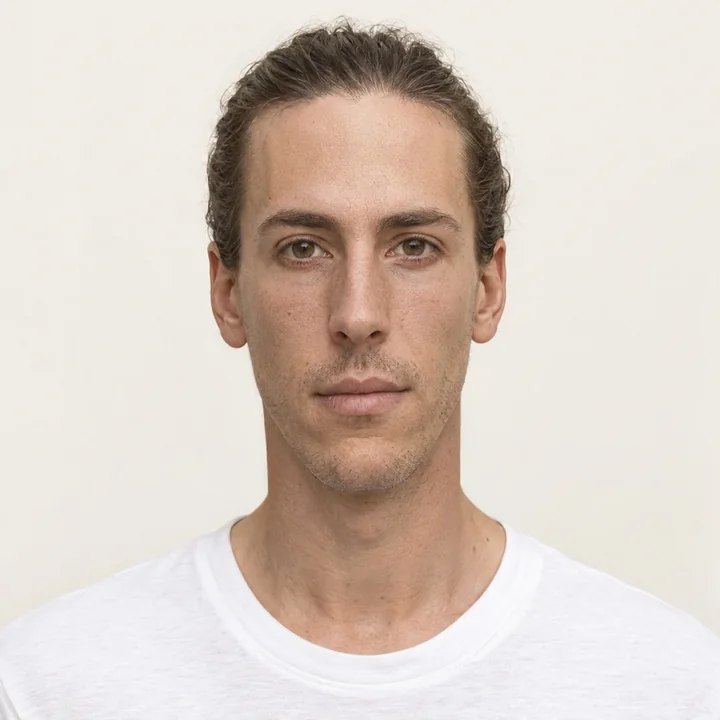
Oblong
Same widths, more length. Oblong starts scoring at a length : width over 1.50 and scores fully over 1.55, with a jaw angle under 108°. Oval sits at 1.38 to 1.52 with a jaw angle of 108° to 116°.
Read the oblong guide →
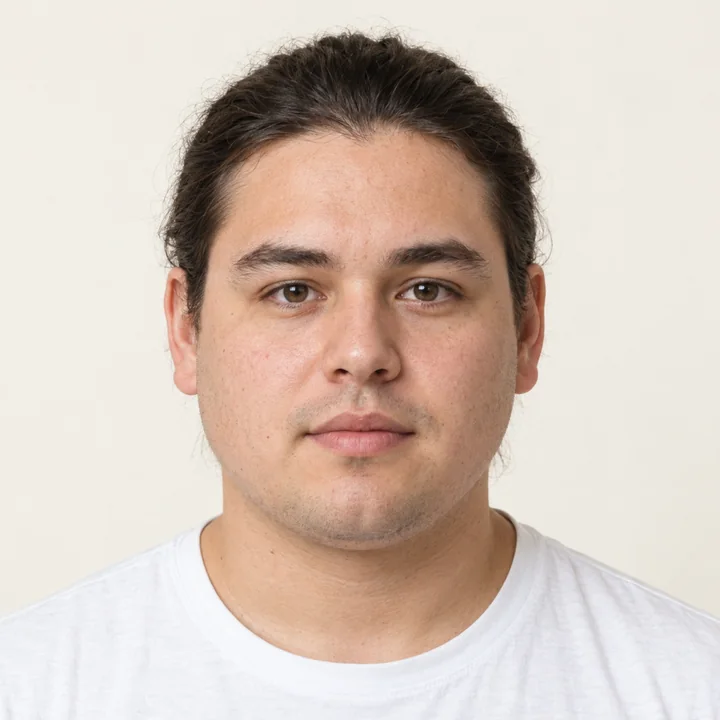
Round
Shorter and softer. Round needs a length : width under 1.38 and a jaw angle over 125°. An oval keeps 1.38 to 1.52 and a jaw angle of 108° to 116°.
Read the round guide →
What fits
Glasses and hair for an oval face.
Conventional advice, stated in terms of the ratios above: frames and volume either add width where the face is narrow or add length where it is wide.
Glasses
- Most frame shapes work because there is no angle to correct. Choose by size rather than shape.
- Frames about as wide as the face, or a touch wider, keep the proportions. A frame narrower than the cheekbones pinches the middle.
- Slightly squared or rectangular frames add a little structure to the soft outline if you want it.
- Avoid very deep lenses that cover the cheekbones. They are the widest point and worth showing.
Hair
- Almost any length works. The one thing to avoid is heavy volume on top with nothing at the sides, which pushes the outline toward oblong.
- Hair that shows the cheekbones (tucked behind the ear, a side part, layers at cheek level) leans into the widest point.
- Fringes are fine but keep them light. A heavy, straight fringe shortens the face toward round.
- Beards: keep the sides tight and the chin modest. A long chin beard lengthens the face.
Bone vs soft tissue
What changes and what doesn't.
Face shape is mostly bone. The distance from the hairline to the chin, the width across the cheekbones and the width at the temples are set by the skull and do not move. The jaw readings, the jaw : face width and the jaw angle, sit under soft tissue: fluid, fat and the masseter all change them by a few points, which is enough to move a face across a shape border.
Oval is mostly bone: the cheekbone width and the distance from the hairline to the chin do not move. What drifts is the jaw ratio. Fluid in the lower face after salt, alcohol or a poor night widens the jaw : face reading toward round, and uneven masseter tone from chewing on one side can pull the jaw angle a couple of degrees off. That is why the same face can read oval in the morning and closer to round in the evening.
FAQ
Is oval the most attractive face shape?+
No shape is. Oval gets called ideal in magazine guides because most frames and haircuts sit well on it, which is a styling convenience, not a ranking. Shape is a description of ratios, and the detector reports it that way.
Can my face shape change?+
The bone does not, so an oval stays oval. Weight, fluid and jaw muscle tone change the jaw : face ratio and the jaw angle by a few points, which can move a borderline oval toward round or oblong on a given day. The length and the cheekbone width stay put.
Why did the detector say I'm between oval and another shape?+
Because oval sits in the middle of the ranges, it borders round on one side (shorter, wider jaw) and oblong on the other (longer, tighter jaw angle). A length : width near 1.38 or 1.52, or a jaw angle near 108° or 116°, scores points for both. The second bar tells you which way you lean.
Does hair or a beard change the result?+
Yes, if it hides the temples or the jaw. The detector estimates face length from the glabella and chin, so a fringe does not change the length, but hair over the temples changes the forehead reading and a full beard hides the true jaw width. Pull the hair back and, if you can, photograph the jawline uncovered.
Other face shapes
Shape is one reading.
The app measures nineteen.
Canthal tilt, jaw width, midface ratio, symmetry, skin, and a 3D model of your face, each against its ideal band, bone vs trainable, and a plan.