
Face shape guide
Heart face shape
A heart face is widest at the forehead and temples, narrows through the cheekbones, and tapers to a narrow, often pointed chin.

How to tell
- The forehead is the widest part of the face, or as wide as the cheekbones.
- The face narrows steadily from the temples down.
- The chin is narrow and comes to a point rather than a flat edge.
- The jaw is noticeably narrower than the cheekbones.
- A widow's peak is common but not required. The shape is in the widths, not the hairline.
What the detector scores
- Forehead : face width
- Over 0.955 · half credit Over 0.945 (under 0.94 counts against)
- Jaw : face width
- Under 0.74 · half credit Under 0.76
- Jaw angle
- Under 109° · half credit Under 113°
- Lower jaw : face width
- Under 0.64 · half credit Under 0.66
Heart has no length rule. Length can be moderate or long; the forehead and the chin decide. Bands are the ones the Face Shape Detector uses on uploaded photos; width is measured at the cheekbones, forehead at the temples, length from an estimated hairline to the chin.
Measure yours
Are you heart? Measure it.
Upload a straight-on photo. 478 landmarks, five readings, a score against all six shapes. Runs in your browser, nothing uploaded.
Often confused with
The two nearest shapes, and the number that separates them.
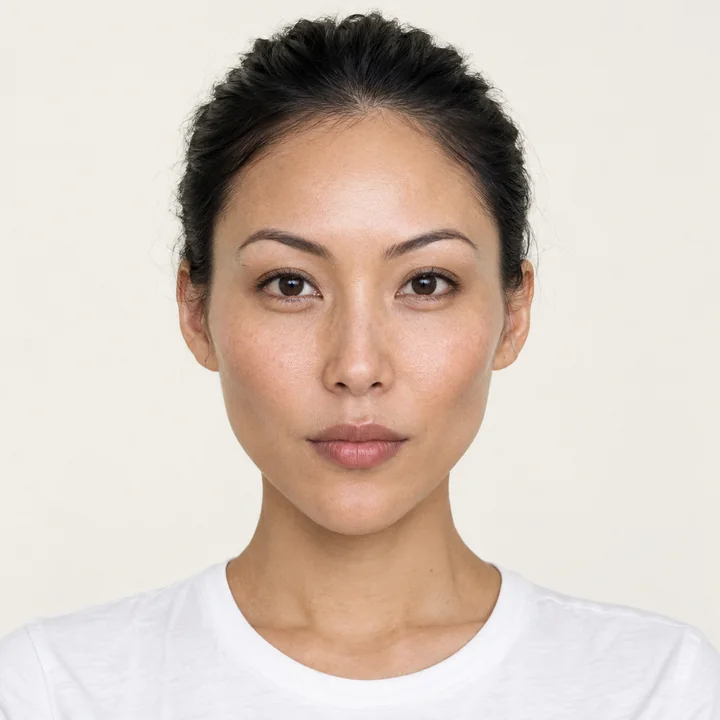
Diamond
Same narrow chin, different forehead. Diamond needs a forehead : face width under 0.935; heart needs over 0.955. Between those two numbers the detector splits the credit.
Read the diamond guide →
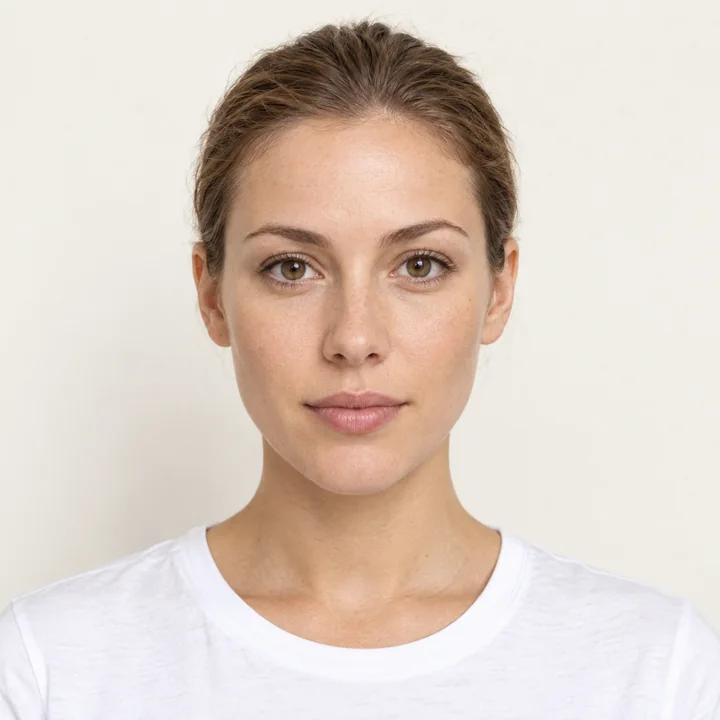
Oval
Wider jaw, softer chin. Oval scores on a jaw : face width of 0.74 to 0.78 and a jaw angle of 108° to 116°. Heart needs under 0.74 and a chin under 109°.
Read the oval guide →
What fits
Glasses and hair for a heart face.
Conventional advice, stated in terms of the ratios above: frames and volume either add width where the face is narrow or add length where it is wide.
Glasses
- Frames that are wider at the bottom than the top (aviators, rounded bottoms, rimless or light tops) add width where the face narrows.
- Thin rims and lighter colours on the top bar avoid adding weight to the already wide forehead.
- Avoid heavy, wide brow bars and cat-eye frames that flare at the temples.
- Round and oval lenses soften the point of the chin from a distance.
Hair
- Volume at the jaw and chin, not the crown: chin-length cuts, layers that flick out at the jaw.
- A side-swept fringe narrows the forehead. A very short fringe widens it.
- Avoid slicked-back styles and tight high ponytails that expose the full width of the temples.
- Beards: a fuller beard at the jaw and chin balances the narrow lower face. Keep the cheeks trimmed.
Bone vs soft tissue
What changes and what doesn't.
Face shape is mostly bone. The distance from the hairline to the chin, the width across the cheekbones and the width at the temples are set by the skull and do not move. The jaw readings, the jaw : face width and the jaw angle, sit under soft tissue: fluid, fat and the masseter all change them by a few points, which is enough to move a face across a shape border.
The width at the temples is the frontal bone and does not change. The narrow jaw is partly bone and partly the absence of tissue over it, so this is one shape where the jaw readings can drift the other way: a heavier lower face or fluid raises the jaw : face ratio above 0.74 and the result slides toward oval. Puffiness never changes the forehead reading, so a heart still scores on the top half on a wide-jaw day.
FAQ
Is heart the most attractive face shape?+
No shape is. Heart is often described as feminine because a narrow chin is one of the readings that differs between the sexes on average, but plenty of male faces score heart and it says nothing about how a face reads as a whole. The detector reports the four ratios that define it, nothing more.
Can my face shape change?+
The forehead width is fixed. The lower half can move: weight or fluid widens the jaw and softens the point of the chin, which can push a borderline heart to oval. Weight loss can do the reverse and sharpen the chin reading. The forehead : face ratio stays, so the top-heavy outline persists.
Why did the detector say I'm between heart and another shape?+
The forehead ratio is the deciding number. Above 0.955 you are heart; below 0.935 you are diamond; in between, both get credit and the jaw angle decides. If the second shape is oval, your jaw : face width is close to 0.74 or your chin angle near 109°, which is the border.
Does hair or a beard change the result?+
More than for any other shape. The forehead reading uses the temples, so hair covering them narrows the forehead and can turn a heart into a diamond. A beard widens the jaw and chin and pushes the result to oval. Pull the hair back off the temples and, if possible, photograph the bare jawline.
Other face shapes
Shape is one reading.
The app measures nineteen.
Canthal tilt, jaw width, midface ratio, symmetry, skin, and a 3D model of your face, each against its ideal band, bone vs trainable, and a plan.