
Face shape guide
Oblong face shape
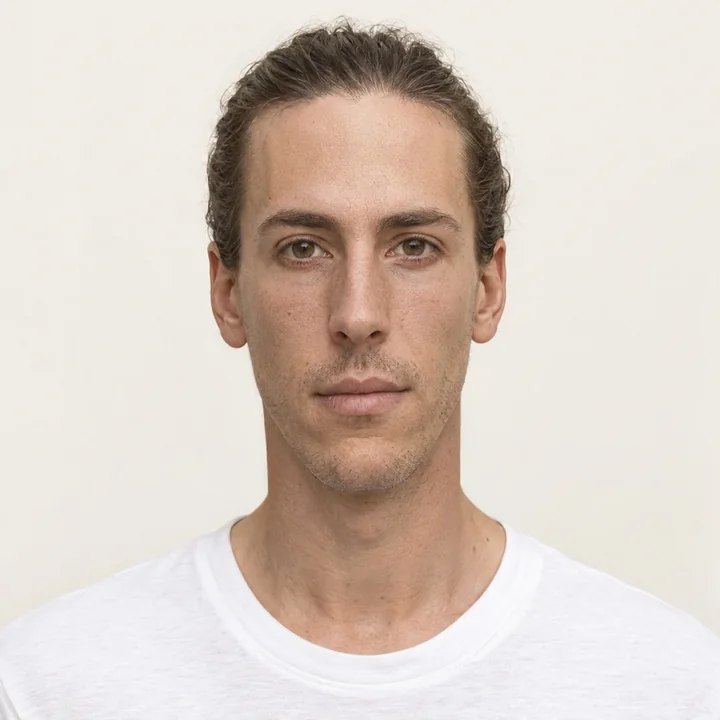
An oblong face is a longer oval: length more than one and a half times the width, straight sides, similar widths at the forehead, cheeks and jaw, and a narrow chin.
How to tell
- The face is clearly longer than it is wide, more than one and a half times.
- Forehead, cheekbones and jaw are all close in width. The sides run nearly straight.
- The chin is narrow and the jaw angle is tight, so the lower face tapers over a long distance.
- The forehead is often tall, with the hairline set high.
- No single widest point stands out. The outline is a long, rounded rectangle.
What the detector scores
- Length : width
- Over 1.55 · half credit Over 1.50
- Jaw angle
- Under 108° · half credit Under 112°
- Jaw : face width
- 0.75 – 0.79 (small bonus)
Oblong has no forehead or lower-jaw rule. Length does most of the work; the tight jaw angle confirms it. Bands are the ones the Face Shape Detector uses on uploaded photos; width is measured at the cheekbones, forehead at the temples, length from an estimated hairline to the chin.
Measure yours
Are you oblong? Measure it.
Upload a straight-on photo. 478 landmarks, five readings, a score against all six shapes. Runs in your browser, nothing uploaded.
Often confused with
The two nearest shapes, and the number that separates them.
Oval
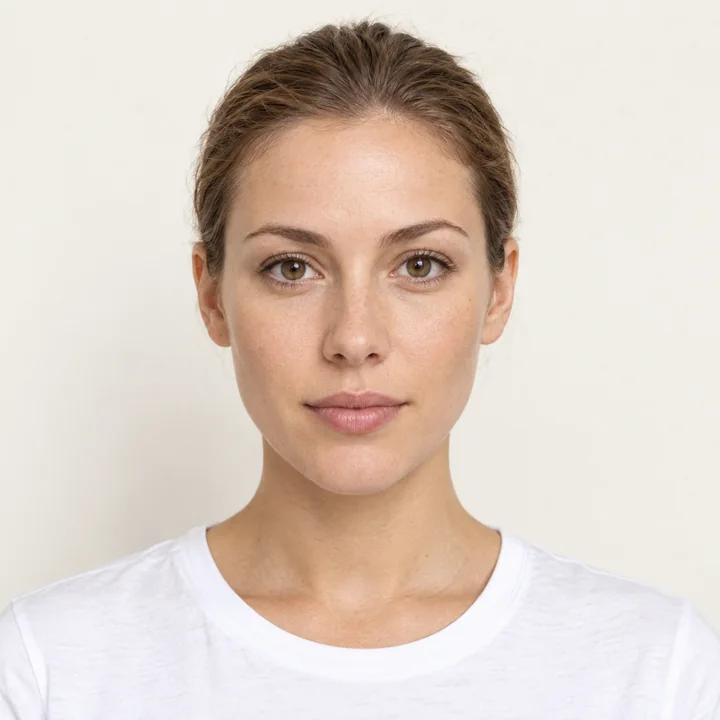
Same widths, less length. Oval scores at 1.38 to 1.52 with a jaw angle of 108° to 116°. Oblong needs over 1.55 and an angle under 108°.
Read the oval guide →
Square
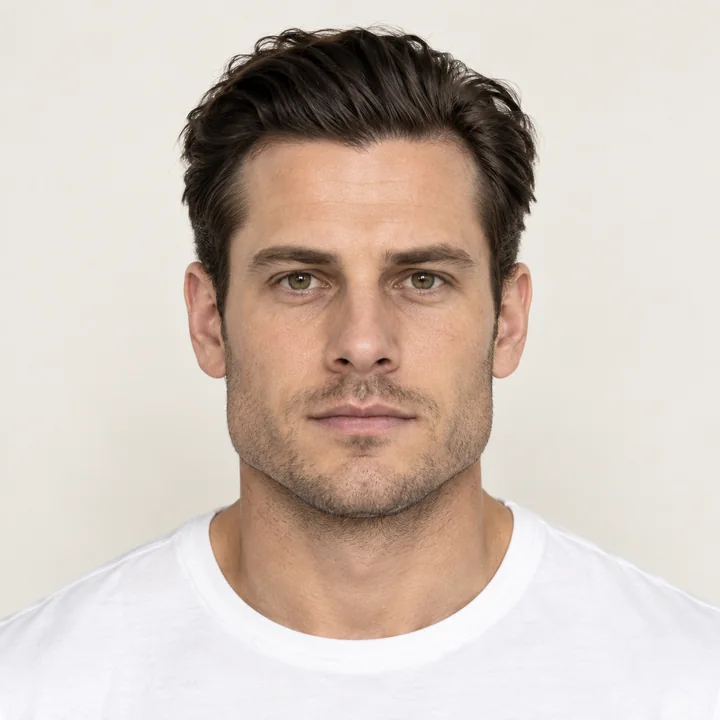
Both have straight sides; the ratios differ everywhere else. Square is under 1.45 long with a jaw : face width over 0.83 and a corner at 118° to 128°. Oblong is over 1.55 with a jaw angle under 108°.
Read the square guide →
What fits
Glasses and hair for an oblong face.
Conventional advice, stated in terms of the ratios above: frames and volume either add width where the face is narrow or add length where it is wide.
Glasses
- Tall, deep lenses (large squares, rounded rectangles, oversized frames) cover more vertical distance and shorten the face.
- A low bridge and a decorative or heavier temple arm add width at the sides.
- Avoid narrow, shallow lenses that draw a thin horizontal line and leave the length above and below.
- Round frames add width and soften the straight sides.
Hair
- Volume at the sides, not the top. Width at the cheekbones and jaw shortens the outline.
- A fringe covers a tall forehead and takes visual length off the face.
- Avoid height at the crown, long straight lengths with no layers, and slicked-back styles.
- Beards: keep the chin short and the sides full. A long chin beard adds length to a face that already has it.
Bone vs soft tissue
What changes and what doesn't.
Face shape is mostly bone. The distance from the hairline to the chin, the width across the cheekbones and the width at the temples are set by the skull and do not move. The jaw readings, the jaw : face width and the jaw angle, sit under soft tissue: fluid, fat and the masseter all change them by a few points, which is enough to move a face across a shape border.
Face length is bone. The detector estimates the hairline from the glabella-to-chin distance, so neither a fringe nor a receding hairline moves the number, even though both change the look. The jaw angle is the reading that can move: fluid and masseter bulk open the angle by a couple of degrees, which can push an oblong face at 107° to a long oval at 110°. Nothing soft shortens the face, so the shape is stable; what varies day to day is the second bar.
FAQ
Is oblong the most attractive face shape?+
No shape is. Oblong gets fewer flattering adjectives than the others in styling guides, which says something about guides and nothing about faces. The detector reports a length : width ratio and a jaw angle. How a face reads depends on the whole set of readings, not the shape label.
Can my face shape change?+
The length does not, so an oblong face stays long. The jaw angle can open a few degrees with fluid or masseter bulk, which moves a borderline oblong to oval. A receding hairline lengthens the look but not the reading, because the detector estimates the hairline from the glabella rather than finding it in the hair.
Why did the detector say I'm between oblong and another shape?+
Almost always oval. A length : width between 1.50 and 1.55 earns partial credit for oblong while still inside oval's partial band, and a jaw angle between 108° and 112° scores for both. If the second shape is square, your jaw is wide for an oblong and the sides are very straight.
Does hair or a beard change the result?+
The length reading runs from an estimated hairline to the chin, so a fringe does not shorten it. Hair over the cheeks narrows the measured width and makes the face read longer, so pull it back. A beard that adds width at the jaw opens the jaw angle and can shift the result to oval.
Other face shapes
Shape is one reading.
The app measures nineteen.
Canthal tilt, jaw width, midface ratio, symmetry, skin, and a 3D model of your face, each against its ideal band, bone vs trainable, and a plan.