
Face shape guide
Diamond face shape
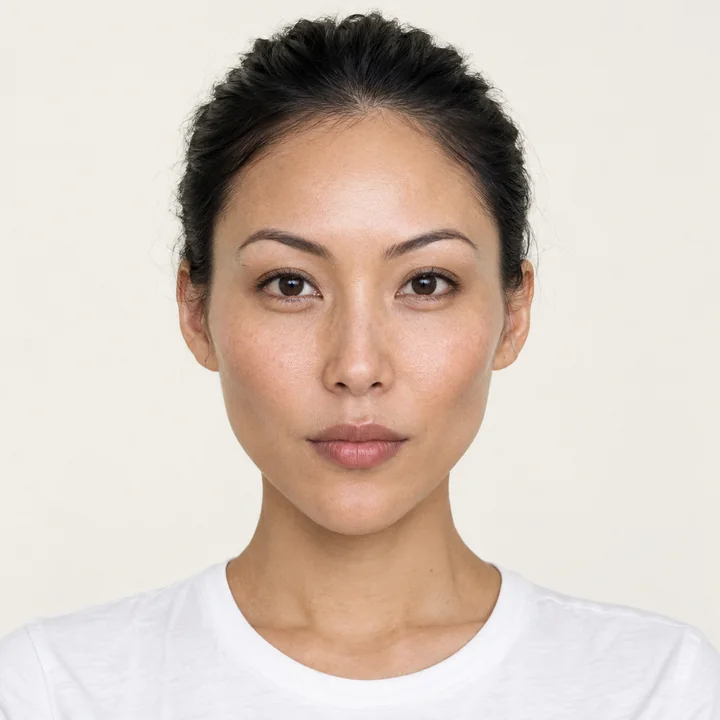
A diamond face is widest across the cheekbones, with both the forehead and the jaw noticeably narrower, and a narrow, pointed chin.
How to tell
- The cheekbones are clearly the widest point and stand out from the outline.
- The forehead is narrow at the temples, narrower than the cheekbones.
- The jaw is narrow too, so the face tapers both up and down from the cheeks.
- The chin is narrow and pointed.
- The hairline is often narrow. The outline reads as a rhombus with the points at the top and bottom.
What the detector scores
- Forehead : face width
- Under 0.935 · half credit Under 0.945 (over 0.955 counts against)
- Jaw : face width
- Under 0.75 · half credit Under 0.77
- Jaw angle
- Under 112° · half credit Under 116°
- Lower jaw : face width
- Under 0.64 · half credit Under 0.66
Diamond has no length rule. It is the narrow forehead that separates it from heart. Bands are the ones the Face Shape Detector uses on uploaded photos; width is measured at the cheekbones, forehead at the temples, length from an estimated hairline to the chin.
Measure yours
Are you diamond? Measure it.
Upload a straight-on photo. 478 landmarks, five readings, a score against all six shapes. Runs in your browser, nothing uploaded.
Often confused with
The two nearest shapes, and the number that separates them.

Heart
Same chin, opposite forehead. Heart needs a forehead : face width over 0.955; diamond needs under 0.935. Only the temples separate them.
Read the heart guide →

Oval
Oval has a wider forehead and jaw: a jaw : face width of 0.74 to 0.78 and a jaw angle of 108° to 116°. Diamond needs a jaw under 0.75 and an angle under 112°, with the temples narrow.
Read the oval guide →
What fits
Glasses and hair for a diamond face.
Conventional advice, stated in terms of the ratios above: frames and volume either add width where the face is narrow or add length where it is wide.
Glasses
- Frames that add width at the brow line (browline frames, a top-heavy rim, a modest cat-eye) balance the narrow temples.
- Oval and rounded rectangular lenses soften the cheekbone point.
- Frames about as wide as the cheekbones. Wider than that exaggerates the widest line.
- Avoid narrow, small frames that leave the cheekbones as the only wide thing on the face.
Hair
- Width at the temples and at the jaw: a side fringe, layers that start at the forehead, a chin-length cut.
- Avoid volume at the cheekbone line, which is already the widest point.
- Avoid slicked-back or very short styles that expose a narrow hairline.
- Beards: a beard adds width to the jaw and squares the chin, which brings the lower half toward the cheekbones.
Bone vs soft tissue
What changes and what doesn't.
Face shape is mostly bone. The distance from the hairline to the chin, the width across the cheekbones and the width at the temples are set by the skull and do not move. The jaw readings, the jaw : face width and the jaw angle, sit under soft tissue: fluid, fat and the masseter all change them by a few points, which is enough to move a face across a shape border.
The cheekbone width is the zygomatic arch and does not change. The two narrow readings differ. The forehead : face ratio is bone. The jaw : face ratio and the chin angle are the soft-tissue readings, so a diamond face that gains weight or holds fluid drifts toward oval as the jaw widens past 0.75. Cheek fat can also hide the cheekbone point so the face looks less diamond while the bone is unchanged.
FAQ
Is diamond the most attractive face shape?+
No shape is. Diamond is the least common of the six and is sometimes called striking because high, prominent cheekbones are one of the readings people notice, but rarity is not a rank. The detector reports the ratios that make the shape.
Can my face shape change?+
The cheekbones and the temple width are fixed. The jaw readings drift with weight and fluid: a wider jaw pushes a diamond toward oval, and losing cheek fat can make an oval reveal a diamond outline. The forehead ratio, which separates diamond from heart, does not move.
Why did the detector say I'm between diamond and another shape?+
If the second shape is heart, your forehead : face width is between 0.935 and 0.955, the band where both get credit. If it is oval, your jaw : face width is near 0.75 or your chin angle is near 112°. Diamond is a narrow band on two readings, so a small change in either tips it.
Does hair or a beard change the result?+
Yes. Hair covering the temples narrows the measured forehead and pushes a result toward diamond even on a heart or oval face, so pull it back. A beard widens the jaw and the chin, moving the result toward oval or square. Photograph with the temples and jaw visible.
Other face shapes
Shape is one reading.
The app measures nineteen.
Canthal tilt, jaw width, midface ratio, symmetry, skin, and a 3D model of your face, each against its ideal band, bone vs trainable, and a plan.