
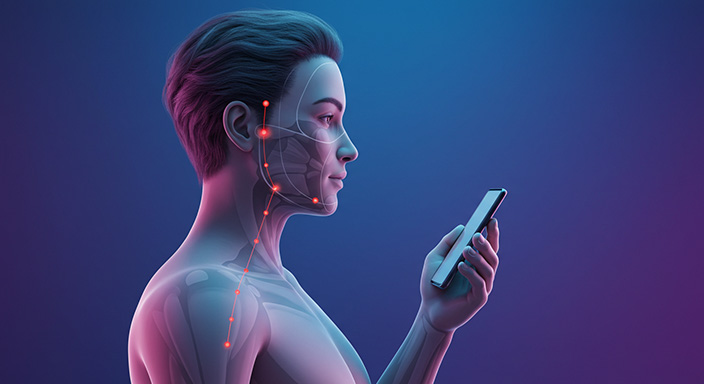
We've all been there: hunched over our laptops during a marathon work session, scrolling through TikTok with our necks craned forward, or squinting at our phones in dim lighting. But what if we told you that your screen habits aren't just affecting your productivity—they're actually changing the way your face looks?
Measure yours · freeFace Symmetry TestSymmetry index plus eight left-right readings. About 30 seconds from one photo.Try it →Welcome to the era of "tech face," where our digital dependencies are creating new beauty challenges that go far beyond the occasional breakout from touching our phones. From premature wrinkles to facial asymmetry, the way we interact with screens is literally reshaping our appearance. Here's everything you need to know about this modern beauty crisis—and how to glow up while staying plugged in.
The Science Behind "Tech Face"
Vision is one of the main inputs your body uses to organise posture, so when your eyes strain, your posture—and possibly your face—can pay the price. Digital eye strain is common: a 2018 review estimated it may affect 50% or more of computer users, which makes this a beauty concern hiding in plain sight.
Here's what's happening: When you struggle to see your screen clearly, your body instinctively moves into whatever position gives you the best view. This usually means jutting your head forward, squinting, tilting your neck, or hunching your shoulders. These seemingly innocent adjustments are actually creating a cascade of changes that affect everything from your jawline to your forehead.
If you can't see well, you may squint, lean forward, or tilt your head into an unnatural position to see more clearly. Those movements can create muscle tightness in the shoulders, neck, and head, and some experts think repeated tension may gradually show in your expression lines.
The Beauty Breakdown: What Screen Time Does to Your Face
Forward Head Posture = Instant Age-Add
That slight forward lean you do when reading emails? It may be adding years to your appearance. One spine model estimates that tilting your head forward by just 15 degrees raises the load on your neck from 10-12 pounds to about 27 pounds. Over time, this posture may contribute to:
- Double chin enhancement: Forward head posture compresses the area under your chin
- Neck creasing: Constantly looking down creates horizontal lines across your neck
- Jawline softening: Poor posture affects the definition of your jaw
- Shoulder rounding: Which makes your neck appear shorter and less elegant
The Squinting Epidemic
Straining to see screens leads to chronic squinting, which creates:
- Crow's feet acceleration: Repetitive eye muscle contractions deepen expression lines
- Forehead wrinkles: Raising eyebrows to compensate for poor vision
- Under-eye tension: Creating that tired, aged look even when you're well-rested
- Facial asymmetry: If you consistently tilt your head to one side to see better
"Tech Neck" Goes Beyond the Neck
The postural changes from screen use create a domino effect:
- Compressed facial features: Poor posture affects how your features align
- Reduced blood flow: Affecting your natural glow and skin health
- Muscle tension headaches: Which can cause a perpetually stressed expression
- TMJ issues: Leading to jaw tension and potential facial pain
The Glow-Up Game Plan: Your Anti-Tech Beauty Protocol
Screen Setup for Stunning Posture
Transform your workspace into a beauty-preserving zone:
✨ The 20-Inch Rule: Keep screens 20-28 inches from your face (about arm's length)
✨ Eye-Level Excellence: Position your screen so the center sits 4-5 inches below eye level
✨ Lighting Luxury: Ensure your screen brightness matches your room lighting to reduce squinting
✨ Font-Size Freedom: Don't be shy about increasing text size—your future self will thank you
The 20-20-20 Beauty Break
This isn't just good for your eyes—it's a mini facial workout:
Every 20 minutes: Look at something 20 feet away for 20 seconds
Bonus beauty hack: Use this time for:
- Quick facial massages
- Neck rolls and shoulder shrugs
- Conscious facial relaxation (release that unconscious squint!)
- Deep breathing to reduce overall tension
Facial Fitness: Your Anti-Screen Workout
The Tension-Release Routine
Happy Face Reset: Smile as wide as possible, hold for 5 seconds, then completely relax. Repeat 10 times.
Brow Smooth: Gently massage your forehead in upward strokes to release squinting tension.
Eye Circle Magic: Close your eyes and gently roll them in slow circles (3 times each direction) to relieve strain.
Neck Nobility: Practice chin tucks against a wall to retrain proper head positioning.
The Screen-Break Facial
Turn your mandatory work breaks into beauty moments:
Minute 1: Palm your closed eyes with warm hands (this increases circulation and relaxes muscles)
Minute 2: Massage temples, jawline, and the base of your skull
Minute 3: Practice conscious blinking and facial relaxation
Beauty Tech: Gadgets That Help
Blue Light Glasses: Popular, but a Cochrane review found they may not reduce eye strain from computer use, so don't count on them for squint lines
Ergonomic Accessories: Laptop stands, external keyboards, and adjustable monitors are beauty investments
Posture Apps: Set reminders to check your posture throughout the day
Desktop Humidifiers: Combat the dry air that contributes to eye strain and skin dehydration
The Professional Touch: When to Seek Help
If you're experiencing persistent:
- Facial tension or headaches
- Neck and shoulder stiffness
- Changes in your facial symmetry
- Chronic squinting despite corrective lenses
Consider consulting:
- An optometrist: For proper screen-viewing prescriptions
- A physical therapist: For posture correction techniques
- A facial massage therapist: For targeted tension release
- An ergonomics specialist: For optimal workspace setup
Your Glow-Forward Future
The good news? Unlike many beauty concerns, much of "tech face" is likely preventable, and some of it may be reversible with consistent care. By making small adjustments to how you interact with screens, you're not just protecting your vision—you're preserving your most valuable beauty asset: your natural, relaxed, glowing self.
Remember: Your posture is your most accessible beauty tool. Stand tall, position your screens properly, and watch as better tech habits transform not just how you feel, but how you look. Because in the age of endless video calls and selfies, good posture isn't just about health—it's about looking absolutely radiant in every frame.
The bottom line: Your screen time doesn't have to steal your glow. With the right habits, you can stay connected and look stunning while doing it.
Ready to glow up your tech habits? Start with just one change today—your future self (and your selfies) will thank you.
Sources
- Sheppard AL, Wolffsohn JS. Digital eye strain: prevalence, measurement and amelioration. BMJ Open Ophthalmology, 2018. PubMed 29963645 — review estimating digital eye strain may affect 50% or more of computer users, and covering screen breaks and other management.
- Hansraj KK. Assessment of stresses in the cervical spine caused by posture and position of the head. Surgical Technology International, 2014. PubMed 25393825 — a model estimating the load on the neck as the head tilts forward: 10 to 12 pounds upright, about 27 pounds at 15 degrees, 60 pounds at 60 degrees.
- Singh S, Keller PR, Busija L, et al. Blue-light filtering spectacle lenses for visual performance, sleep, and macular health in adults. Cochrane Database of Systematic Reviews, 2023. PubMed 37593770 — 17 trials; blue-light filtering lenses may not reduce eye strain from computer use in the short term.
- Chaves TC, Turci AM, Pinheiro CF, et al. Static body postural misalignment in individuals with temporomandibular disorders: a systematic review. Brazilian Journal of Physical Therapy, 2014. PubMed 25590441 — found evidence of head and neck posture changes in jaw-muscle disorders, but no evidence of whole-body postural misalignment in people with these disorders; most studies were of poor quality.