
Verdict: changes the look, not the face. Frames, light direction and colour move nothing on the skull. They change what the eye compares, and the research on lenses shows how large that effect can be. This is craft with one measurable fact per method: the tools can check what your face is doing before the glasses go on.
The lens comes first
Before frames or light, the camera has already decided a lot. In one study, the same 45 people were photographed under identical conditions at 50, 85 and 105 mm equivalent focal lengths and rated by 369 people. The share of men judged attractive rose from 13.5% at 50 mm to 51.1% at 105 mm; for women, 19.2% at 50 mm to 41.0% at 85 mm. Nothing changed but the lens. A phone held at 12 inches makes the base of the nose read about 30% wider than a photo taken from further back. Any assessment of your symmetry from a selfie is an assessment of a wide lens up close.
So the first rule of reading your own face: step back, zoom in, or hand the phone to someone across the room. Your camera has an opinion, and it is not a flattering one.
Frames and the eyes
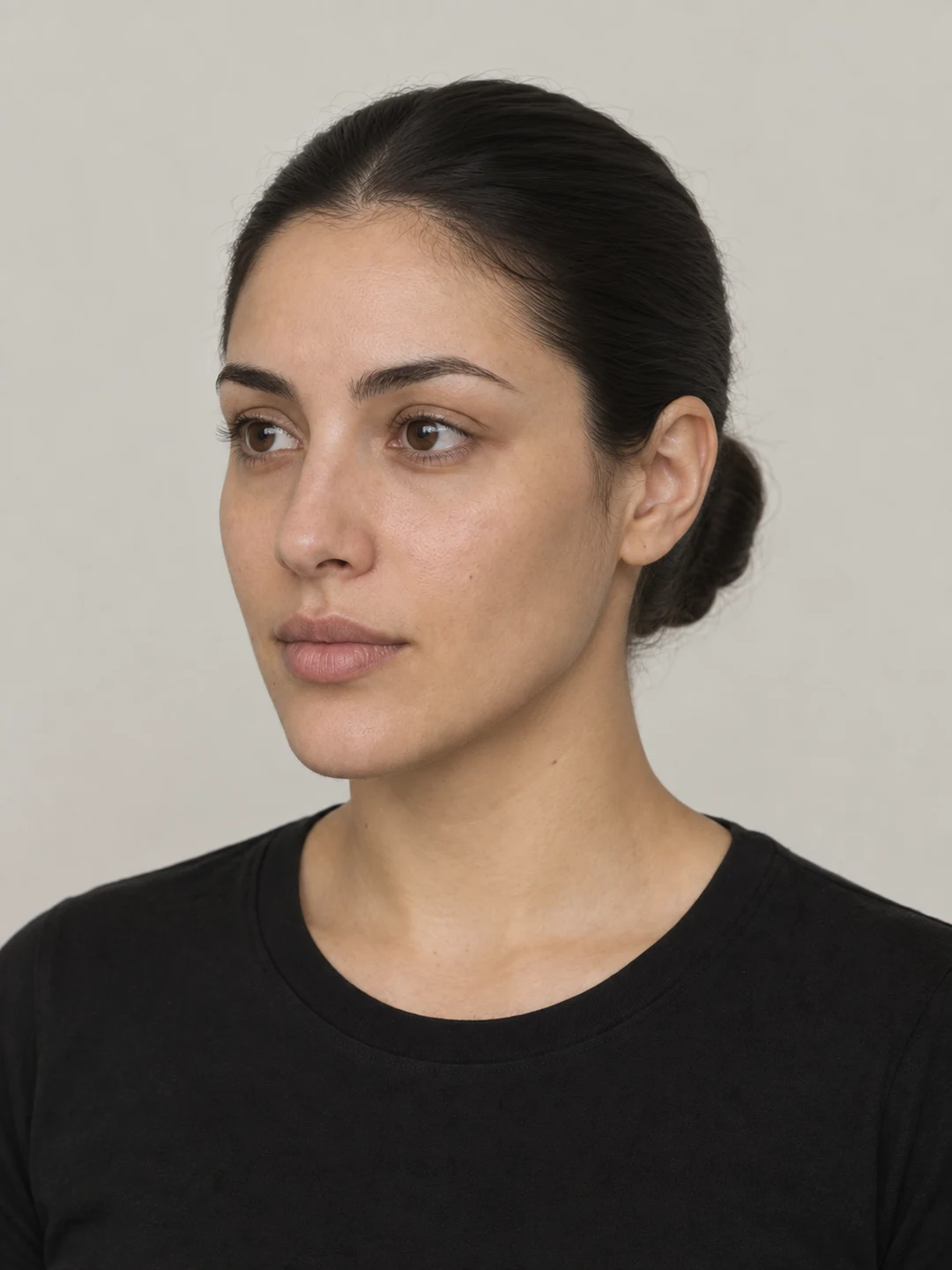
Glasses put a horizontal line across the most-compared region of the face. Used well, that line does the comparing for you.
- Frame width against canthal tilt. The canthal tilt tool reads the angle from inner to outer eye corner in degrees, per side. If one eye tilts more than the other, a frame whose top edge is straight and level gives the eye a reference and makes the difference visible. A frame whose top edge rises toward the outer corners, a cat-eye or an upswept rectangle, follows the tilt, and the difference between sides disappears into the shape.
- Bridge position. The bridge sits on the nose, and the nose is the most symmetric part of the face: midline landmarks differ by only 0.6 to 0.7 mm left to right. That makes the bridge the one reliable centre you have. Frames that sit centred on the bridge look centred even when the eyes are not.
- Ears are not level. In 130 adults the two ears differed in height by only 0.5 mm, but what differs is the angle at which they attach. That is why glasses sit crooked on a face whose ears look fine. The fix is at the temple tips, bent by an optician, not in the frame. A frame that sits level is the single biggest thing glasses can do for apparent symmetry, and it costs nothing.
- Brow height. If one brow is higher, a frame with a heavy top bar hides where the brows sit relative to it. A rimless or thin-top frame shows both brows against a single line.
Light direction
Light from the front and slightly above, the standard for clinical and passport photography, fills both sides equally and shows the face as it is. Light from one side draws a shadow line down the nose and under the cheekbone on the far side. That shadow reads as depth, and it reads as asymmetry, because the two sides are now lit differently even if they are shaped identically.
That is the whole trick. Front light equalises; side light exaggerates. For a photo you want to look balanced, put the light source behind the camera. For a photo you want to look sculpted, put it to the side and accept that the far side will read as the smaller one. For measuring anything, use front light every time, because the symmetry tool reads landmarks, and a shadow moves where the edge of a feature appears to be.
Head tilt does the same job as side light. In a study of 155 people, facial asymmetry was detected in 97% of those who habitually tilted the head and 86% of those who habitually turned it, against 34% of controls. Some of that is real; some is the photo. Level the head before judging anything.
Colour
Colour cannot move a feature, but it can decide which side is noticed. Two rules cover most of it.
Contrast draws the eye. A strong colour or a hard edge on one side, an ear cuff, a single bright earring, a bold patch of blush, pulls attention to that side. Put it on the side you want people to look at, which is usually the side with the higher brow or the more open eye, and keep the other side quiet.
Warmth reads as fullness. Warm, light tones advance; cool, dark tones recede. Makeup and even the tone of a frame can lean on this: a slightly warmer, lighter frame on a slimmer-looking side, or a subtle highlight there, brings it forward; a cooler tone or a soft contour on the fuller side sits it back. This is the same logic the people who have been drawing one brow higher than the other for ten years already use, and they are right.
The check
None of this changes a reading, and that is how you know it worked. Take one photo in flat front light without glasses and run it through the canthal tilt and symmetry tools. Those are the numbers. Then put the frames on, change the light, and look at the photo instead of the readings. The face you are choosing is the same face, framed better.
Sources
Focal length and attractiveness: Třebický V et al., PLoS ONE 2016;11(2):e0149313. Selfie distance and nose width: Ward B et al., JAMA Facial Plastic Surgery 2018;20(4):333-335. Midline landmark symmetry: PMC3481973. Ear height and attachment angle in 130 adults: PMC9426708. Head tilt and turn in 155 people: PMC10432935. Styling guidance is craft, not a study.