
Free recessed chin test · side photo
Do I Have a Recessed Chin?
Is your chin recessed, or does it only look that way in photos? Upload one side photo. The test traces your profile, measures the angle from your brow to the base of your nose to your chin, and checks your chin against a line down from your lower lip, the same check people do in the mirror. You get a clear answer, from recessed to strong chin, drawn on your own profile.
Drop a side photo, or choose a file
A true side-on photo: camera at face height, hair off the forehead and jaw, plain background.
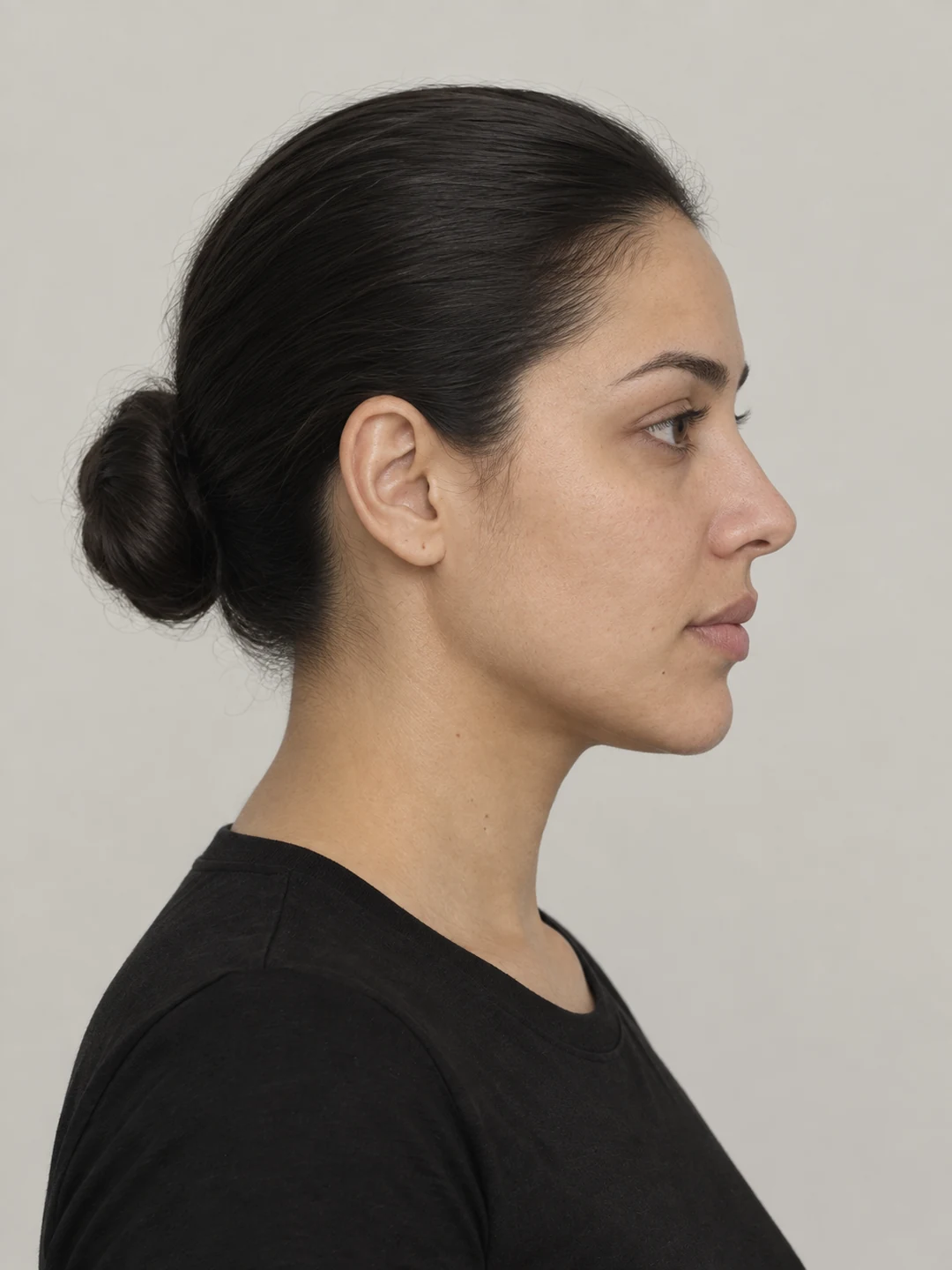
Runs in your browser. Your photo never leaves your device.
How it is measured
The profile angle decides it.
A recessed chin, also called a weak, receding or retruded chin, sits behind the line of the face. The standard way to see it in profile is the facial convexity angle: the brow, the point under the nose and the chin. Most profiles measure about 165–175°. Below that the chin sits further back; above about 177° it sits forward. The test also measures your chin against a line dropped from your lower lip along your face's own vertical, so a slightly tilted head counts less.
- Profile angle
- Brow – under the nose – chin. The main reading: under about 163° the chin sits back.
- Chin vs lower-lip line
- How far your chin sits ahead of or behind a line down from your lower lip, as a share of the nose-to-chin height.
- Chin vs under-nose line
- The same against a line down from the point under your nose.
- Mentolabial angle
- The fold between the lower lip and the chin. A very deep fold often comes with a chin that sits back.
Measure it yourself
How to check for a recessed chin yourself
A mirror and a level head get you most of the way; a side photo gets you a number.
- 1Stand side-on to a mirror, or have someone take a photo exactly from the side with the camera at face height.
- 2Keep your head level and look straight ahead. Lifting your chin hides a recessed chin; dropping it exaggerates one.
- 3Picture a vertical line down from your lower lip. A chin that comes close to the line is typical; one that sits well behind it reads recessed.
- 4Relax your lips. Pushing them out moves the line forward and makes any chin look further back.
- 5Upload the side photo above for the measured profile angle instead of an eyeballed line.
Skip the ruler: the free tool above does it from one photo in about 30 seconds ↑
What's normal
Recessed chin by profile angle
The profile angle is measured at the point under the nose, between the brow and the chin.
- Under 158°
- Chin: Recessed
- Note: The chin sits clearly behind the line of the face.
- 158° – 163°
- Chin: Slightly recessed
- Note: Mildly convex; posture and head angle can move it.
- 163° – 177°
- Chin: Not recessed
- Note: Straight to mildly convex, the common range.
- Over 177°
- Chin: Strong, forward chin
- Note: Straight to concave: the opposite of recessed.
Angles describe a photo, not a clinical assessment. A turned head, a tilted camera or hair over the jaw changes them.
Sources
What this is based on.
The measurement and its reference ranges come from published research. Studies use different methods and populations, so compare your number with the range shown on this page rather than with other tools.
- 1.
Legan HL, Burstone CJ (1980). Soft tissue cephalometric analysis for orthognathic surgery. Journal of Oral Surgery. PubMed 6932485
Soft-tissue profile analysis, including the facial convexity angle (brow – under-nose – chin).
- 2.
Ricketts RM (1968). Esthetics, environment, and the law of lip relation. American Journal of Orthodontics. PubMed 5238879
Defined the esthetic line from nose tip to chin used to describe where the lips sit.
- 3.
Fitzgerald JP, Nanda RS, Currier GF (1992). An evaluation of the nasolabial angle and the relative inclinations of the nose and upper lip. American Journal of Orthodontics and Dentofacial Orthopedics. PubMed 1456217
The nasolabial angle and the inclinations of the nose and upper lip, measured in adults.
Our own data: how much each reading moves when the same face is photographed again is published on the methodology page. How we choose sources.
Related tools
Side Profile Analysis
All eight profile angles, traced automatically.
Jawline Test
Jaw angle, jaw width ratio, chin offset, chin height.
Gonial Angle Calculator
Your jaw angle from a side photo.
Nose Shape Test
Your nose type from the same side photo.
Jaw to Cheekbone Ratio
Bigonial ÷ bizygomatic: tapered, balanced or square.
Face Fat Calculator
Your face fat level from Lean to Full.
PSL Score Test
A measured 1–8 PSL rating with your tier.
FAQ
What is a recessed chin?+
A chin that sits further back than the rest of the profile, so the face reads convex from the side. People also call it a weak, receding or retruded chin. It can come from a small or set-back lower jaw, a small chin bone, or posture that pushes the head forward.
Do I have a recessed chin or a weak jawline?+
They often go together but are measured differently. A recessed chin is about where the chin sits in profile; a weak jawline is about how defined the jaw looks from the front. Run the Jawline Test with a front photo to see the second one.
Why does my chin look recessed in photos?+
Head and camera angle. Looking slightly up, a camera held above you, or a wide-angle phone lens close to the face all push the chin back visually. A level, side-on photo from a couple of metres is the fair test.
Can a recessed chin be fixed?+
The options that move the chin forward are clinical: orthodontics or jaw surgery when the bite is involved, a chin implant or genioplasty, and filler for a temporary change. A dentist, orthodontist or facial surgeon can say which applies. Standing and sitting with your head back over your shoulders also stops the chin looking further back than it is.
Does mewing fix a recessed chin?+
No clinical trial has shown that mewing moves an adult chin forward. Holding the tongue up and the head back can change how the jaw looks in a photo, but not the bone.
Can I use a selfie?+
No. A recessed chin only shows in profile, so the test needs a true side photo. With a front selfie it asks for a side photo instead of guessing.
Is my photo uploaded?+
No. The test runs in your browser and your photo never leaves your device.
One reading here.
Nineteen in the app.
A controlled scan, every reading against its ideal band, bone vs trainable, a plan, and a 3D model on Face ID iPhones.