
Free hunter eyes filter · runs in your browser
Canthal Tilt Filter
What would you look like with a positive canthal tilt, a negative one, or hunter eyes? Add a straight-on selfie and tilt your own eyes: drag the slider up or down, or tap Positive tilt, Hunter eyes or Negative tilt. The edited photo is measured again, so you watch the angle move in degrees. It is a preview on your own photo, and the photo stays in your browser.
Drop a selfie, paste one, or choose a file
Straight on, both eyes open, hair and glasses off the eyes.


Runs in your browser. Your photo never leaves your device.
NewSymmi Lab · full face analysis
Your eyes are one reading. Your face has 30.
Your eyes, brows and lashes read in full, the haircut and brow shape that make them stand out, plus your score, your colours and your plan.
- Your face score and where you rank
- 4 haircuts tried on your own face
- Your colours, shades and a step-by-step plan
$6.99 once · no subscription · ready in minutes
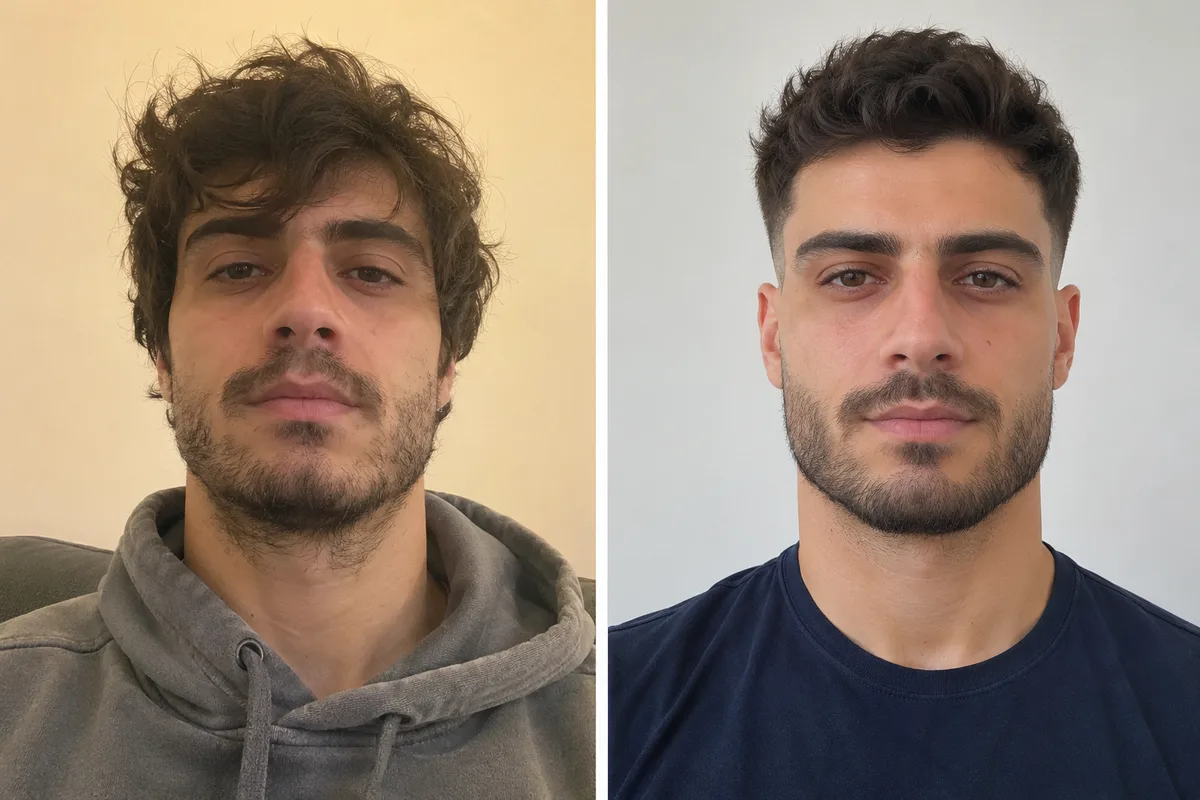
Sample result
Three looks, one photo
Positive tilt, negative tilt or hunter eyes: see all three on your face.
A few degrees at the outer corner change how a whole face reads. Each preset is fitted to your own eyes: the filter edits the photo, measures the result and corrects the amount so the angle lands close to where the preset aims. Between the presets, the slider is yours.
Positive canthal tilt filter
Lifts the outer corners until your eyes measure about +6°: the upswept, alert look. On Symmi's scale anything from +2° up is positive.
Hunter eyes filter
A positive tilt of about +5° with lower brows, a narrower opening and a longer outer corner. The three hunter traits a photo can show, on your own eyes.
Negative canthal tilt filter
Lowers the outer corners to about −4°: the softer, downturned look. See what tilt alone does to the same face.
Want the real numbers? The filter shows what a tilt would look like. The Canthal Tilt Calculator measures the tilt you have, and the Hunter Eyes Test checks all three hunter traits on your photo.
How it is measured
It moves your eye corners. It does not generate a new face.
The face model places 478 landmarks on your photo. The filter then tilts each eye opening about its pupil: for a positive tilt the outer corner rises and the inner corner drops a little, for a negative tilt the reverse, and the line from corner to corner turns. The lids stay where they are over the iris, the brow follows by about half, and every pixel is placed with the same smooth, rigid warp as the Face Slimmer. Your irises, nose, mouth and face outline are pinned and a ring outside your face is held still, so nothing but the eye area changes. When the slider rests, the edited photo goes back through the Canthal Tilt Calculator's measurement: inner corner to outer corner, with head roll removed.
- Tilt slider
- From −12° to +12°, applied to both eyes and marked in degrees of change in the measured tilt. Right lifts the outer corners, left lowers them.
- What moves
- Both eye corners in opposite directions, the lids between each corner and the iris, the skin beside the outer corner and, by about half as much, the brow above it.
- What stays
- The irises and pupils, the lids where they cross the iris, the nose, the mouth, the face outline, your hair and the background. Pixels away from the eyes are copied unchanged.
- Hunter eyes slider
- Brows come down toward the lid by up to 8.5% of your eye width, the opening narrows a little from above and below, and the outer corner reaches outward by up to 7%.
- Presets
- Positive tilt aims at about +6° measured, Negative tilt at about −4°, Hunter eyes at about +5° with the hunter slider at 70%. Eyes that already measure close to that go a clear step further, so every preset shows. Each one is set to your eyes by measuring the edited photo and correcting the amount.
- Measured again
- Before and after are read by the same landmark model from the same four eye corners, so the two numbers can be compared with each other.
How to use it
How to use the canthal tilt filter
One straight-on photo is all it takes. The straighter the photo, the cleaner the edit and the truer the measured angle.
- 1Take a straight-on photo at eye level with a relaxed face and both eyes open. Keep your head level, push hair off your eyes and take glasses off.
- 2Upload it and tap Change my canthal tilt. Your current tilt is measured first, for each eye, and shown above the sliders.
- 3Tap Positive tilt, Hunter eyes or Negative tilt for a one-tap look, or drag the tilt slider: right lifts the outer corners, left lowers them.
- 4Add the hunter slider for lower brows and a narrower, longer eye opening on top of the tilt.
- 5Drag the before/after divider across the photo, or press Hold: before, to compare with the original.
- 6Save the side-by-side picture. Its caption carries the measured angle before and after.
Try it on your own photo: the filter above takes about 30 seconds ↑
What's normal
What the measured tilt means
The filter uses the same labels as the Canthal Tilt Calculator. They are Symmi's display cutoffs: they describe direction, not health or attractiveness.
- +2° and above
- Label: Positive
- What it looks like: The outer corner sits higher than the inner corner: the upswept look. The Positive tilt preset aims at about +6°.
- Between −2° and +2°
- Label: Neutral
- What it looks like: The corners are close to level.
- −2° and below
- Label: Negative
- What it looks like: The outer corner sits lower than the inner corner: a softer, downturned look. The Negative tilt preset aims at about −4°.
Hunter eyes are more than tilt. The Hunter Eyes Test also reads the eye opening (0.32 or less reads narrow) and the brow gap (under 0.50 reads low-set).
Sources
What this is based on.
The measurement and its reference ranges come from published research. Studies use different methods and populations, so compare your number with the range shown on this page rather than with other tools.
- 1.
Lee JY, Choung HW, Choung PH (2020). Diagnostic analysis of vertical orbital dystopia and canthal tilt for surgical correction. Journal of the Korean Association of Oral and Maxillofacial Surgeons. PubMed 33377462
Defines the canthal tilt angle that is measured before and after the preview.
- 2.
Rhee SC, Woo KS, Kwon B (2012). Biometric study of eyelid shape and dimensions of different races with references to beauty. Aesthetic Plastic Surgery. PubMed 22810555
Canthal measurements compared across ethnic groups; normal values differ by population.
- 3.
Kartynnik Y, Ablavatski A, Grishchenko I, Grundmann M (2019). Real-time facial surface geometry from monocular video on mobile GPUs. arXiv. arXiv:1907.06724
The face-mesh model that places the 468 surface landmarks this tool measures from.
- 4.
Ablavatski A, Vakunov A, Grishchenko I, et al. (2020). Real-time pupil tracking from monocular video for digital puppetry. arXiv. arXiv:2006.11341
The iris model that adds 10 eye landmarks (478 in total), used for pupil-based reference lines.
Our own data: how much each reading moves when the same face is photographed again is published on the methodology page. How we choose sources.
Related tools
Canthal Tilt Calculator
Your real tilt in degrees, for each eye.
Hunter Eyes Test
Tilt, eye opening and brow gap, each measured.
Hunter Eyes vs Prey Eyes
Both eye areas side by side, with the numbers that separate them.
Eye Shape Detector
What eye shape do I have?
Looksmax Filter
Hunter eyes and a harder jaw on your photo, with PSL before and after.
Face Slimmer
Leaner cheeks and a sharper jaw on your own photo.
PSL Score
Your looks tier from one selfie.
FAQ
Is there a canthal tilt filter online?+
Yes, this one. Upload a straight-on selfie and the filter tilts your own eyes up or down, by as much as 12° either way, with one-tap presets for positive tilt, negative tilt and hunter eyes. It is free, needs no sign-up and runs in your browser.
What is positive vs negative canthal tilt?+
Canthal tilt is the angle from the inner eye corner to the outer one. Positive means the outer corner sits higher, which reads upswept and alert. Negative means it sits lower, which reads softer or more tired. On Symmi's scale +2° and above is positive, −2° and below is negative, and anything between is neutral.
What would I look like with hunter eyes?+
Tap Hunter eyes. It gives your eyes a positive tilt of about +5° measured, brings the brows down toward the lid, narrows the opening a little and draws the outer corner outward. Those are three of the traits people mean by hunter eyes. Deep-set sockets, the fourth, cannot be drawn on a flat photo.
What does the negative canthal tilt filter do?+
It lowers the outer corners until your eyes measure about −4°, so you can see the downturned look on your own face. It is useful for comparing: the same face at −4° and at +6° shows how much of a look comes from tilt alone.
Can you change canthal tilt in real life?+
The tilt itself comes from bone structure. Makeup changes how it reads: liner angled up from the outer corner, lashes that are longest at the outer third, and a brow tail that sits higher. Surgery that repositions the outer corner exists and is a matter for a qualified surgeon. This filter is a preview, not advice.
Why does the measured angle differ from the slider?+
The slider is marked in the degrees the measurement is expected to move. The number above it is a fresh measurement: the landmark model looks at the edited photo and finds the eye corners again, and on some faces it follows the edit a little more, on others a little less. So 6° on the slider can read as 5° or 7° of change. The model also follows only part of a change drawn at the corners, so on the photo the corner line turns by roughly twice the slider's value. The presets correct for all of this by measuring the edited photo and adjusting the amount.
Does it change the rest of my face or the background?+
No. Your irises, nose, mouth and face outline are pinned and only a patch around each eye is redrawn. Every pixel outside those two patches is copied exactly as it was.
Is my photo uploaded?+
No. The landmark model and the filter run in your browser, and the photo stays on your device.
One reading here.
Nineteen in the app.
A controlled scan, every reading against its ideal band, bone vs trainable, a plan, and a 3D model on Face ID iPhones.
Symmi Lab · new
Your full face analysis, with 4 haircuts on your own face.