
Free cheekbone test · runs in your browser
Do I Have High Cheekbones?
High or low cheekbones? The quick test people do with their fingers is to find the widest point of the face: right under the eyes means high cheekbones, down near the nostrils means low. This tool does that test with measurements. Upload a straight-on photo and it finds the widest point on each side, places it between your outer eye corners and the base of your nose, and gives you high, medium or low, with how wide your cheekbones are against your jaw.
Drop a photo, paste one, or choose a file
Straight-on, whole face visible, even light. JPG, PNG or WebP.
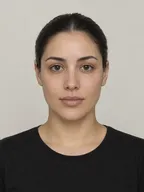

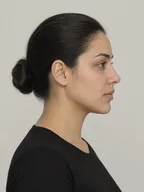
Runs in your browser. Your photo never leaves your device.
How it is measured
Where the widest point of your face sits.
On each side the tool fits a smooth curve through five points of the face outline around the cheek and takes its outermost point: the cheekbone (zygomatic arch) seen from the front. Its height is placed on a scale from 0 at the outer eye corners to 1 at the base of the nose, averaged over both sides. Under 0.15 reads high, 0.15–0.45 medium, over 0.45 low. A straight-on photo shows how high and how wide the cheekbones are; how far they project forward needs a side photo.
- Cheekbone height
- Where the widest point sits between the eye corners (0) and the nose base (1). The main reading.
- Left and right
- Each side on its own. A big difference usually comes from a turned head, hair or side light.
- Cheekbones ÷ jaw
- Cheekbone width over jaw width: how much the cheekbones stand out above the jaw.
- Face fat index
- Fuller cheeks pull the widest point down and soften the cheekbones, so it is shown for context.
Measure it yourself
How to check your cheekbones in the mirror
The finger test, done properly:
- 1Face a mirror straight on in even light, hair pulled back off your cheeks.
- 2Put your index fingers on your cheeks and move them outward until you find the widest, most solid point of the bone.
- 3If that point sits just under your eyes, close to the outer corners, you have high cheekbones.
- 4If it sits lower, level with your nostrils, your cheekbones are low; in between is medium.
- 5Or upload a photo above and the tool finds the point and measures it for you.
Skip the ruler: the free tool above does it from one photo in about 30 seconds ↑
What's normal
What your result means
- Under 0.15
- Reads as: High cheekbones
- Note: The widest point sits close under the eyes: a sculpted, angular midface, the look models are known for.
- 0.15 – 0.45
- Reads as: Medium cheekbones
- Note: The most common result: the cheekbones sit between the eyes and the nose.
- Over 0.45
- Reads as: Low cheekbones
- Note: The widest point sits near the nose: a fuller midface that often reads softer and younger.
No height is better than another. High cheekbones read sculpted, low cheekbones read soft and youthful.
Sources
What this is based on.
The measurement and its reference ranges come from published research. Studies use different methods and populations, so compare your number with the range shown on this page rather than with other tools.
- 1.
Cunningham MR (1986). Measuring the physical in physical attractiveness: quasi-experiments on the sociobiology of female facial beauty. Journal of Personality and Social Psychology. doi:10.1037/0022-3514.50.5.925
Prominent cheekbones were among the features of women's faces rated most attractive.
- 2.
Scheib JE, Gangestad SW, Thornhill R (1999). Facial attractiveness, symmetry and cues of good genes. Proceedings of the Royal Society B. PubMed 10535106
In men's faces, prominent cheekbones (with a longer lower face) went with symmetry and higher attractiveness ratings.
- 3.
Kartynnik Y, Ablavatski A, Grishchenko I, Grundmann M (2019). Real-time facial surface geometry from monocular video on mobile GPUs. arXiv. arXiv:1907.06724
The face-mesh model that places the 468 surface landmarks this tool measures from.
- 4.
Ablavatski A, Vakunov A, Grishchenko I, et al. (2020). Real-time pupil tracking from monocular video for digital puppetry. arXiv. arXiv:2006.11341
The iris model that adds 10 eye landmarks (478 in total), used for pupil-based reference lines.
Our own data: how much each reading moves when the same face is photographed again is published on the methodology page. How we choose sources.
Related tools
Jaw to Cheekbone Ratio
Bigonial ÷ bizygomatic: tapered, balanced or square.
Face Shape Detector
Diamond faces have the widest cheekbones.
Face Fat Calculator
How much fullness sits over your cheekbones.
fWHR Calculator
Face width-to-height ratio.
Makeup for Your Face Shape
Where to contour and highlight.
Face Slimmer
Leaner cheeks on your own photo.
PSL Score Test
A measured 1–8 PSL rating with your tier.
FAQ
Do I have high cheekbones?+
Find the widest point of your face: if it sits just under your eyes, yes. Upload a straight-on photo above and the tool measures where that point sits between your eye corners and your nose, and tells you high, medium or low.
How do you know if you have high or low cheekbones?+
The widest point of the cheekbone is the clue. Close under the outer eye corners is high, level with the nostrils is low. Fuller cheeks can hide high cheekbones, so a lean face shows them more clearly.
Are high cheekbones attractive?+
Prominent cheekbones are one of the features studies link to attractiveness, in women's faces as part of a sculpted, feminine look and in men's faces as part of a masculine one. Low cheekbones come with a fuller midface that often reads younger.
Can I make my cheekbones look higher?+
Yes, visually: contour just under the cheekbone and highlight on top of it, lose body fat so the bone shows, and choose haircuts that keep volume off the cheeks. The bone itself doesn't change without filler or surgery.
Why do my left and right cheekbones read differently?+
Most faces are slightly asymmetric, and a small head turn, hair over one cheek or light from one side moves the outline. The result uses the average of both sides; retake straight on in even light if the two differ a lot.
Is my photo uploaded?+
No. Everything runs in your browser.
One reading here.
Nineteen in the app.
A controlled scan, every reading against its ideal band, bone vs trainable, a plan, and a 3D model on Face ID iPhones.