
Free best side test · runs in your browser
Which Side of My Face Is Better?
Almost everyone has a good side, and photographers know it. Upload a straight-on selfie and the test cuts your face at its measured midline, doubles each half into a full face, and scores both with the same eight-proportion face score. You see your left side and your right side next to each other, which one scores higher and by how much, and the readings where they differ, so you know which side to turn toward the camera.
Drop a photo, paste one, or choose a file
Straight on, even light on both sides, neutral face.
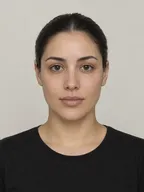
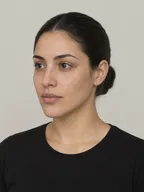
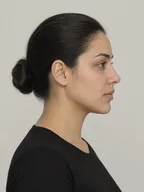
Runs in your browser. Your photo never leaves your device.
How it is measured
Two faces from one photo, scored side by side.
The face landmarks find the midline of your face, the photo is straightened, and each half is mirrored onto the other side to make two complete faces: your left side twice and your right side twice. Each is measured again from scratch and scored on symmetry, facial thirds, face width to height, the midface, eye tilt, eye spacing and the jaw. A gap under 0.1 on the 1–10 score counts as even. Both composites are perfectly symmetrical by construction, so only the comparison between them matters, not the numbers on their own.
- Your right side × 2
- The right half of your face, mirrored into a full face and scored.
- Your left side × 2
- The left half, the same way.
- Better side
- The one that scores higher, and by how much on the 1–10 face score.
- Where they differ
- The readings that differ most between the two sides, such as eye tilt or the jaw.
Measure it yourself
How to use your better side in photos
Once you know it:
- 1Turn your better cheek slightly toward the camera, about 10–20°, so more of that side is in the frame.
- 2Part your hair on the other side, so it doesn't cover your better side.
- 3Put the main light on your better side; the shadow falls on the other.
- 4Take the photo from arm's length or further: a close-up lens exaggerates any difference.
Skip the ruler: the free tool above does it from one photo in about 30 seconds ↑
Sources
What this is based on.
The measurement and its reference ranges come from published research. Studies use different methods and populations, so compare your number with the range shown on this page rather than with other tools.
- 1.
Mita TH, Dermer M, Knight J (1977). Reversed facial images and the mere-exposure hypothesis. Journal of Personality and Social Psychology. doi:10.1037/0022-3514.35.8.597
People preferred their mirror image, while friends preferred their true image: the familiarity effect.
- 2.
Wang TT, Wessels L, Hussain G, Merten S (2017). Discriminative thresholds in facial asymmetry: a review of the literature. Aesthetic Surgery Journal. PubMed 28200081
How much left–right difference people can notice in a face.
- 3.
Kartynnik Y, Ablavatski A, Grishchenko I, Grundmann M (2019). Real-time facial surface geometry from monocular video on mobile GPUs. arXiv. arXiv:1907.06724
The face-mesh model that places the 468 surface landmarks this tool measures from.
- 4.
Ablavatski A, Vakunov A, Grishchenko I, et al. (2020). Real-time pupil tracking from monocular video for digital puppetry. arXiv. arXiv:2006.11341
The iris model that adds 10 eye landmarks (478 in total), used for pupil-based reference lines.
Our own data: how much each reading moves when the same face is photographed again is published on the methodology page. How we choose sources.
Related tools
Mirror Face Test
Your left half doubled, your right half doubled.
Face Symmetry Test
Symmetry index plus eight left-right readings.
True Mirror
Your face un-flipped, the way others see it.
Photo Rater
Find your best picture.
Selfie Distortion
Why close-up selfies look off.
Face Rating
A measured face score out of 10.
PSL Score Test
Your looks tier from one selfie.
FAQ
Which side of my face is better?+
Upload a straight-on selfie: the test doubles each half of your face into a full face, scores both and shows which one scores higher. Most people's sides differ a little; if the gap is under 0.1 points, both sides are equally good.
How do I know if my photo is mirrored?+
Front-camera selfies are often saved the way you see yourself in a mirror. If the photo looks like your mirror (your hair parting on the side you see it in the mirror), it is mirrored: tick the box under the result and the left and right labels swap.
Why does one side of my face look better?+
Faces are never perfectly symmetrical: one eye may tilt up a little more, one side of the jaw may be more defined, one cheek fuller. Small differences like these add up to a side that photographs better.
Is the left side of the face more attractive?+
Some studies found that people show the left cheek more in portraits and rate left-cheek poses as more expressive, but which side is better differs from person to person. That's why measuring your own face is more useful than a general rule.
Why do the doubled faces look strange?+
Real faces are slightly asymmetric, so a face built from one half doubled looks unfamiliar. Only the comparison between the two matters.
Is my photo uploaded?+
No. Everything runs in your browser.
One reading here.
Nineteen in the app.
A controlled scan, every reading against its ideal band, bone vs trainable, a plan, and a 3D model on Face ID iPhones.